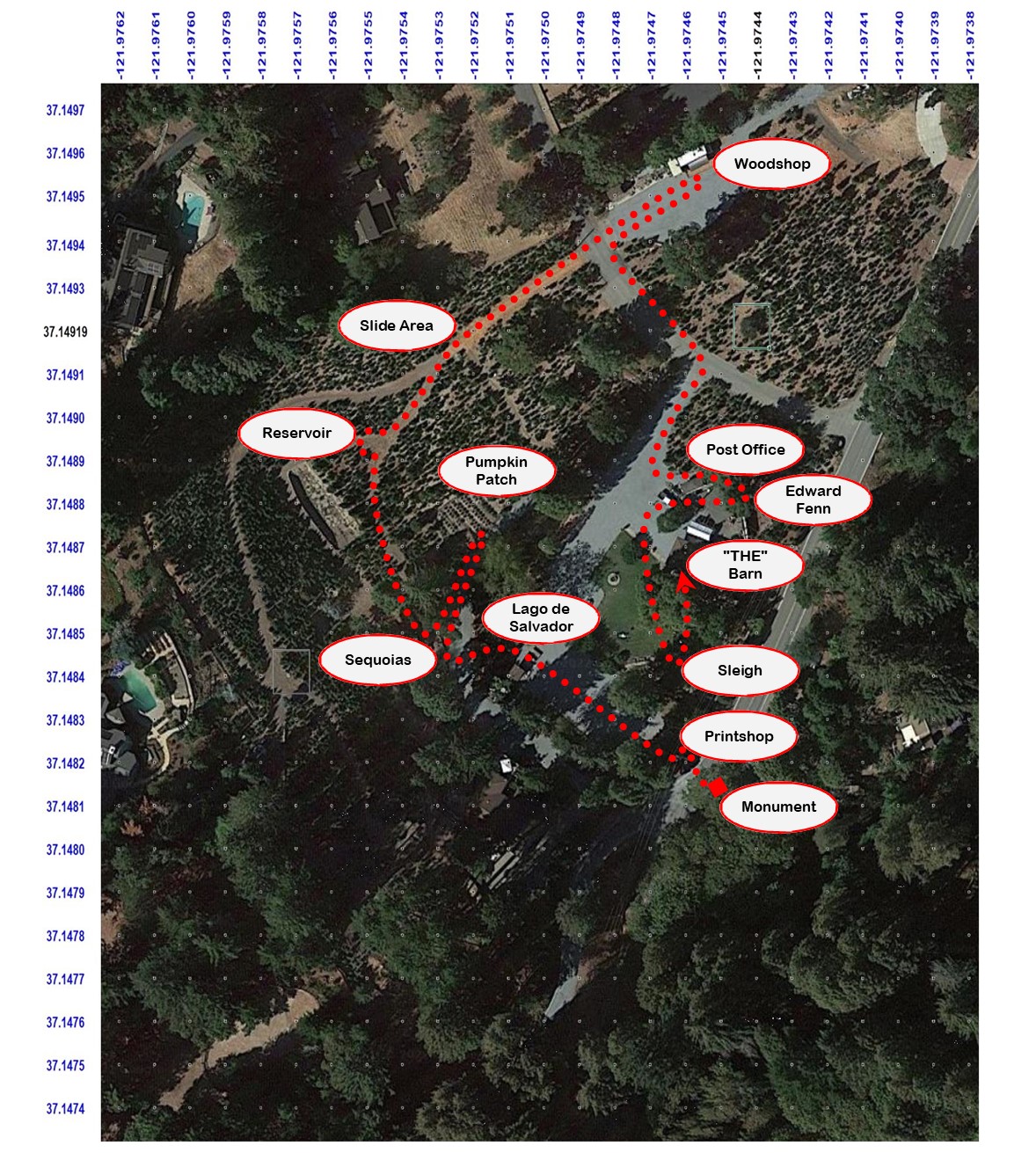
When gold was discovered near Sacramento in 1849, politicians couldn’t resist the potential of huge tax revenue, which put California on the fast track to Statehood a year later. Roads through the wilderness followed, including what is today known as the Old Santa Cruz Highway, built by Charles Henry McKiernan and opened in 1855.
Prior to that time, if Parishioners from Santa Cruz or Carmel wanted to visit the mission at Santa Clara, the choice would be to travel around the southern end of the Mountains by way of Salinas, or along the coast to San Francisco, then down the peninsula. The other, more risky alternative would be to take a chance with the mountain lions and grizzly bears to walk the Ohlone Indian trail – a wandering footpath that would eventually become the new highway.
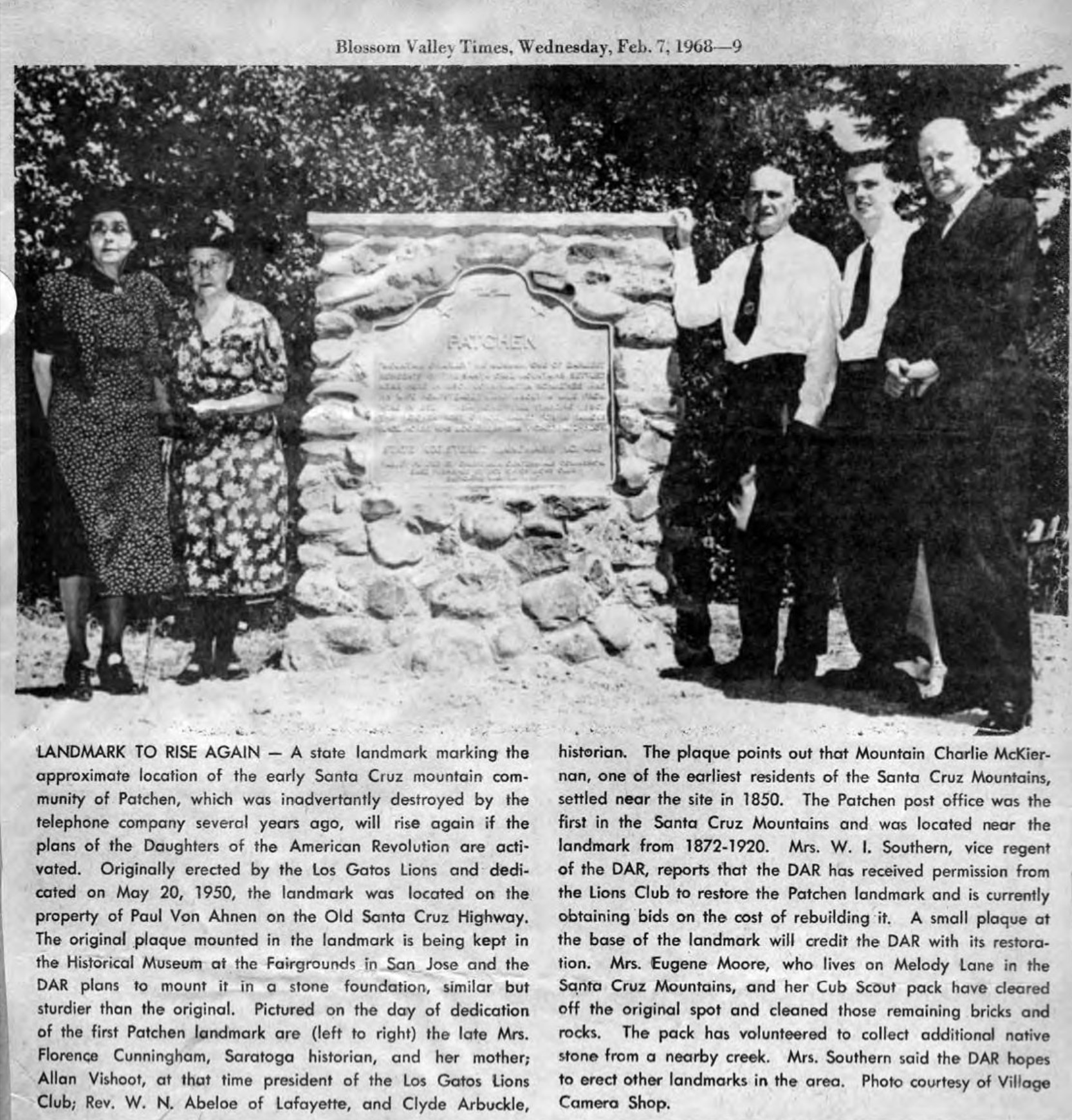
 This monument was dedicated by the California Centennial Commission and mounted on the concrete slab provided by the Los Gatos Lions Club on May 20, 1950. It was restored a few years later by the Los Gatos DAR and is currently (occasionally) maintained in good order by the Loma Prieta Chapter of E Clampus Vitus.
The monument stands next to the area where the livery stable was built in the 1870s, and directly across the road from the Patchen, California, Post Office.
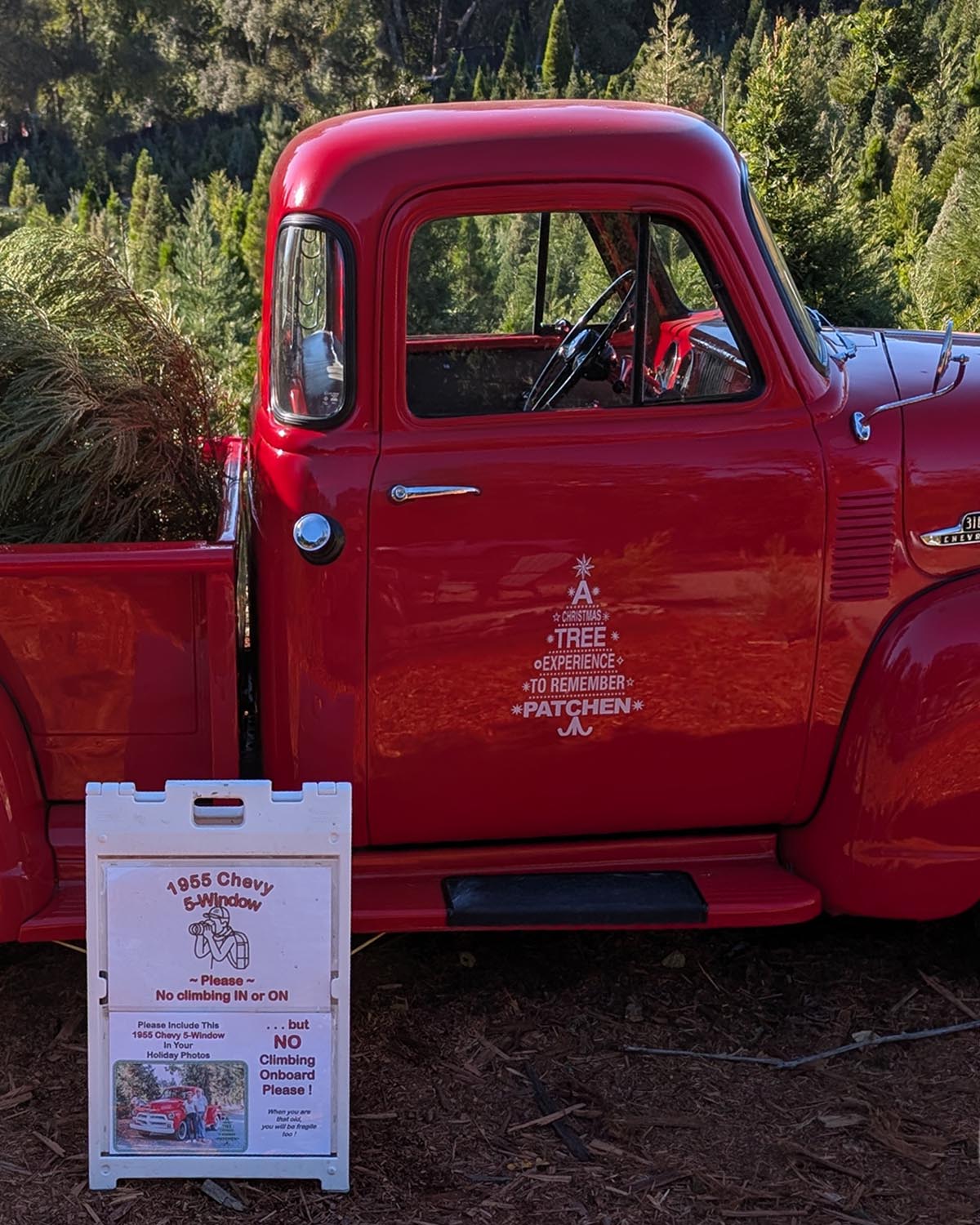
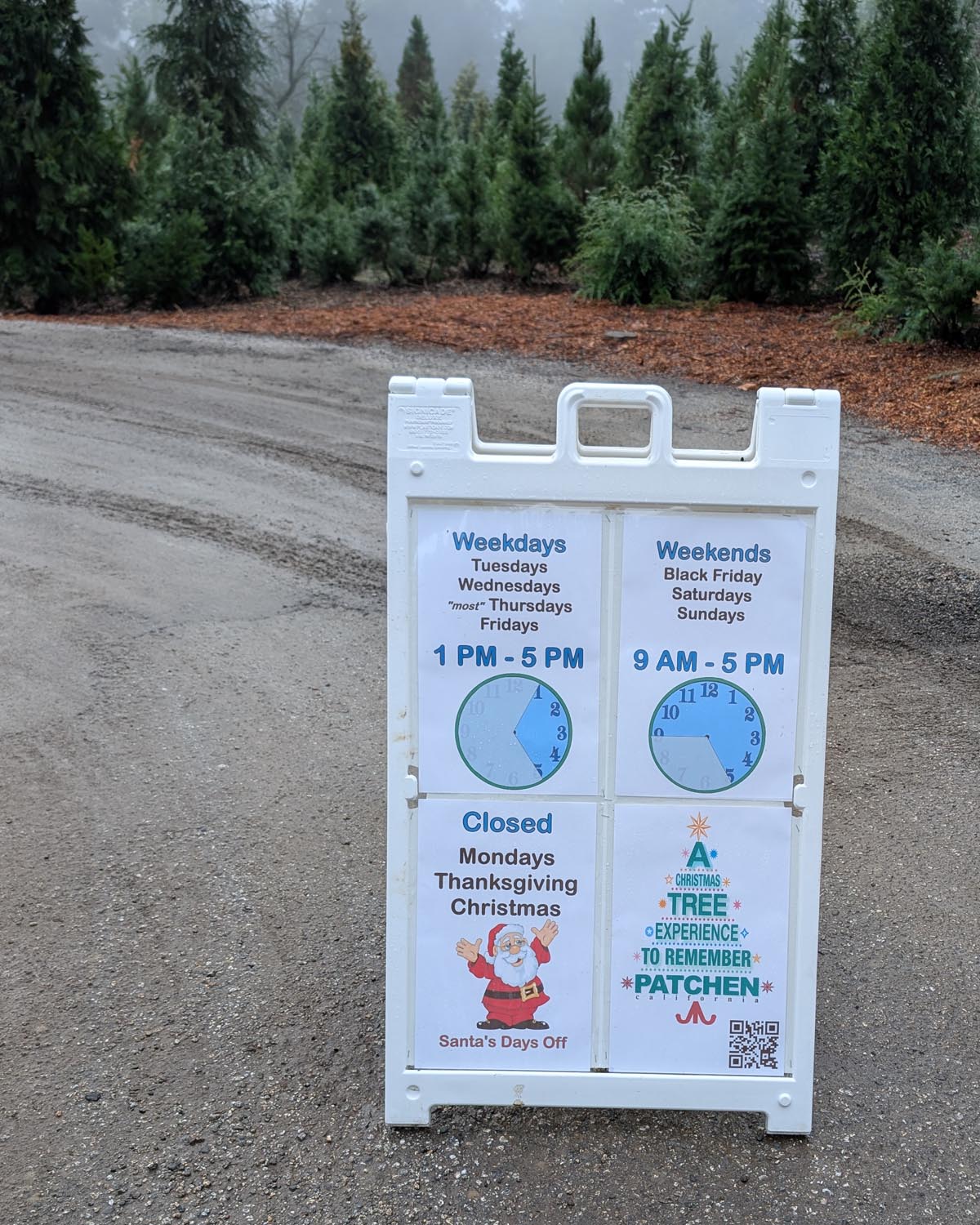
Smartphones with GPS have rendered physical signage posted along highways and hung around neighborhoods far less important than only a few short years ago. It is important, however, at least at Patchen, to help customers with parking and finding what they are looking for – saws, prices, restrooms, etc.
In our soon-to-be six decades of experimenting with signs, we have tried virtually every method known to man – hand painting, stenciling, screen printing, Xeroxing, and offset printing, with photos, drawings, and arrows on every kind of substrate from plywood to aluminum, plastic, and everything in between.
Some folks like nice, professionally painted wooden signs, while others might paint them for themselves. Since needs and tastes change with time, our focus is on Fast, Flexible, Inexpensive, Disposable, therefore Zero-Maintenance, paper signs.
- Use Adobe or a free program like Canva, or others, to design it.
- Print it on paper, including a colorful image from Google.
- Laminate it in plastic to protect it from the weather.
- Staple it to a wall, a signboard, a post, or a tree.
- When you change your mind, you change your sign in under 15 minutes.
- Save it for next year or throw it away & make a new one for under $1.00
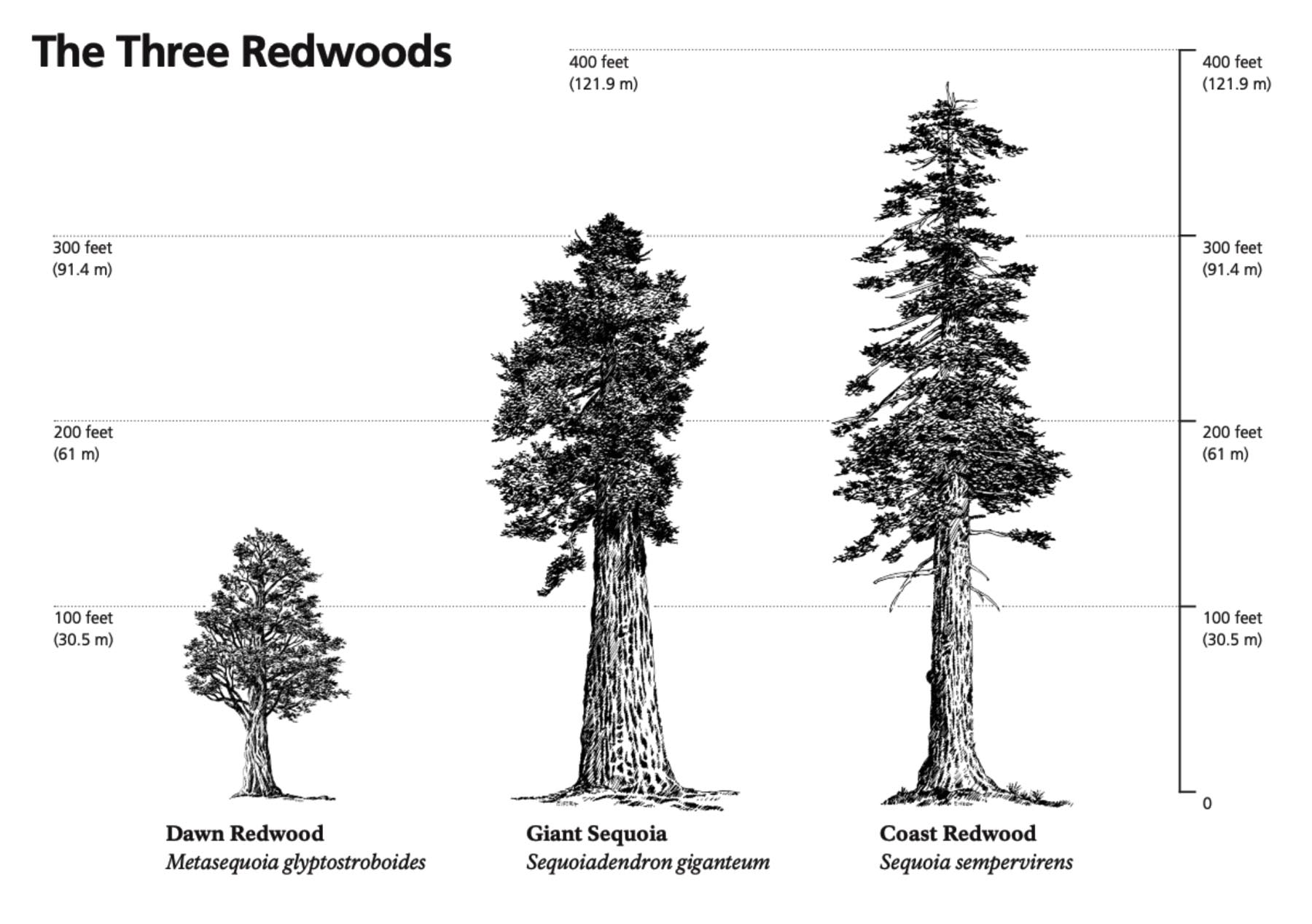
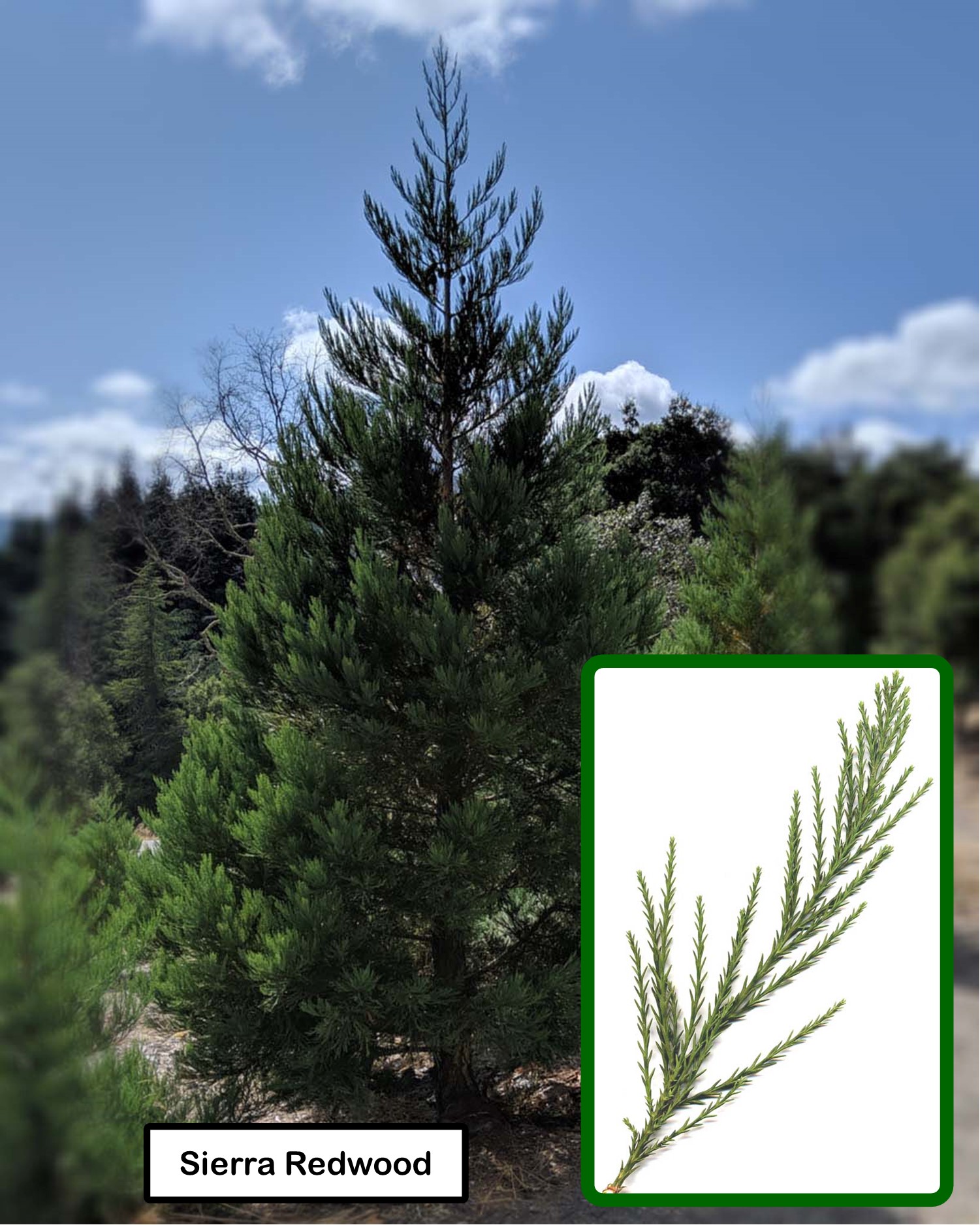
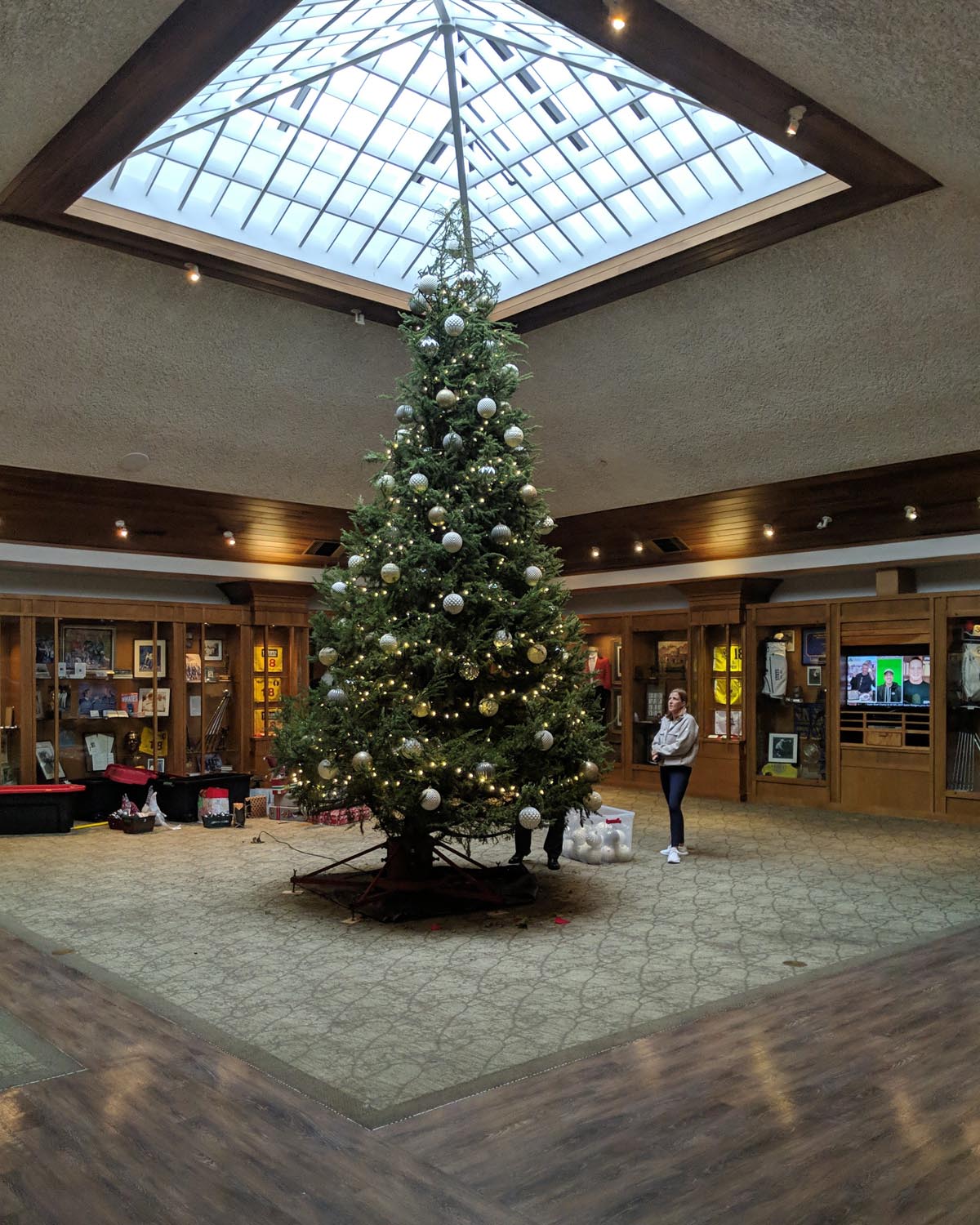
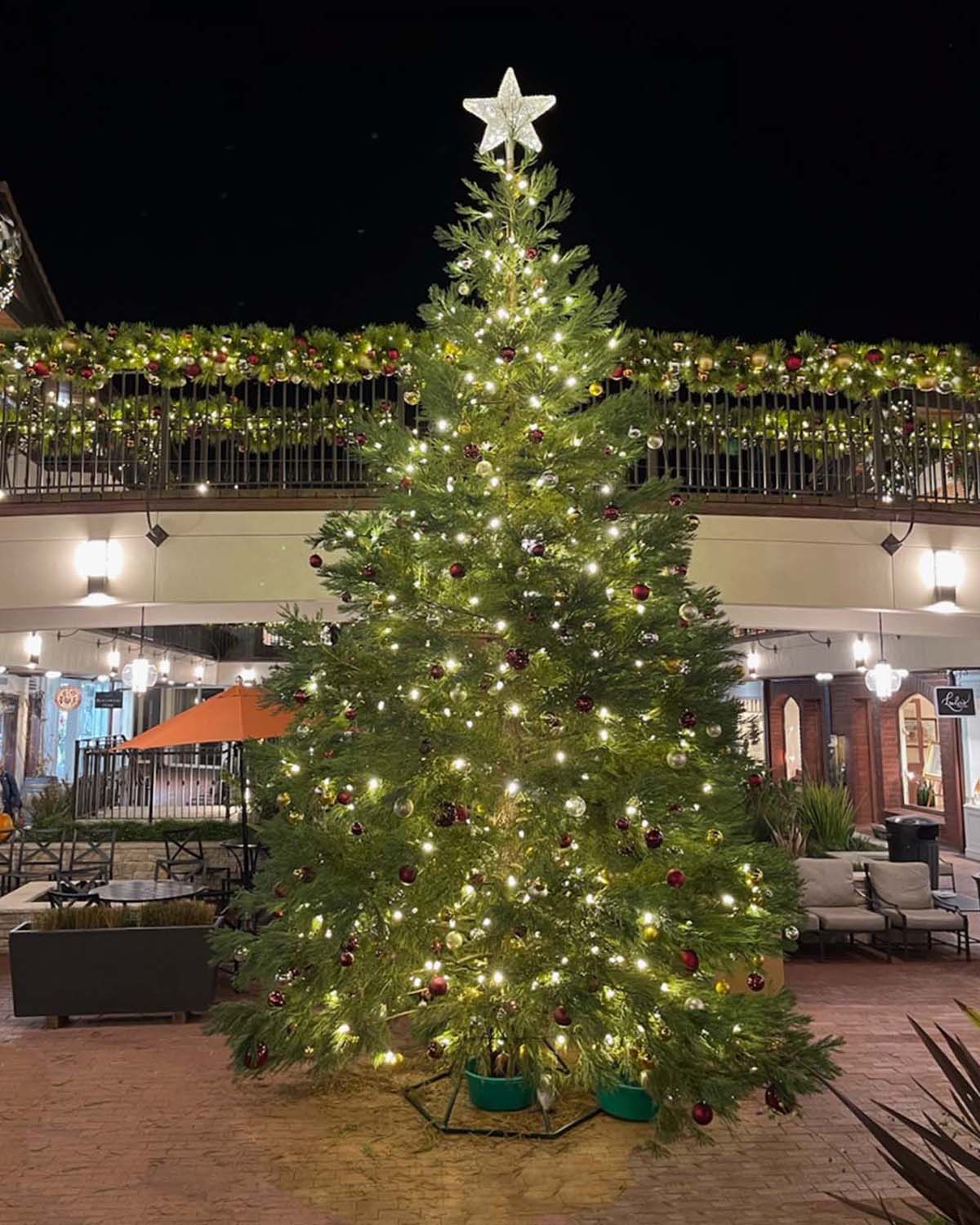
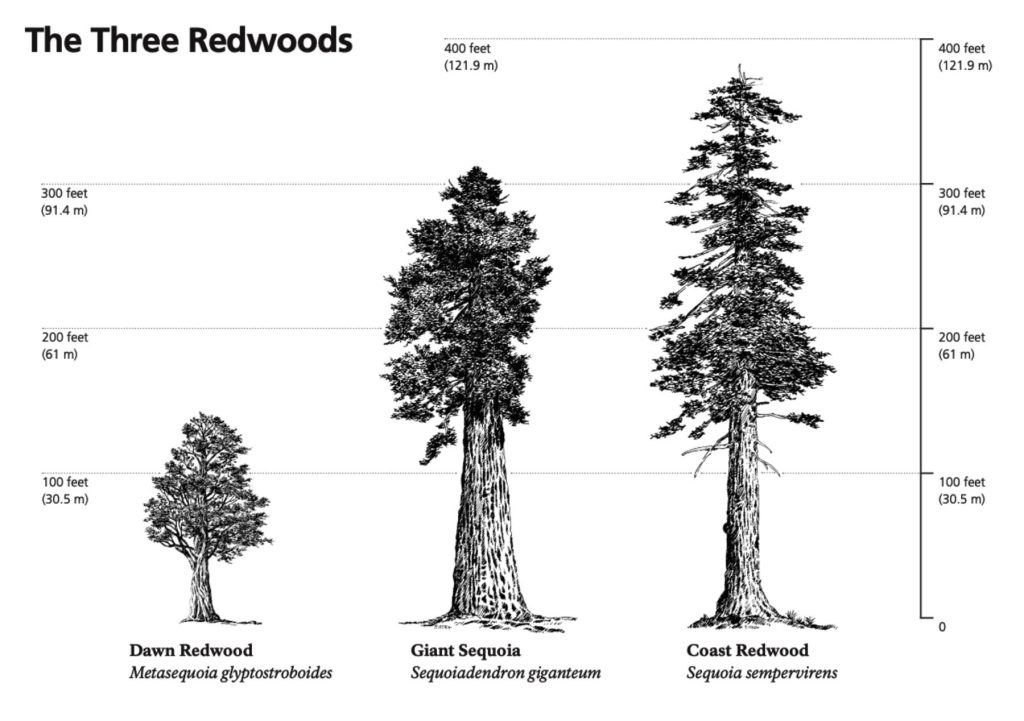
Of the three members of the Sequoia family, the two we have in California both make good Christmas trees.
- The species from the Sierras (Sequoiadendron giganteum) grows fast and requires almost no maintenance, making it a good “budget” variety. Young families like them because pets and toddlers only touch once.
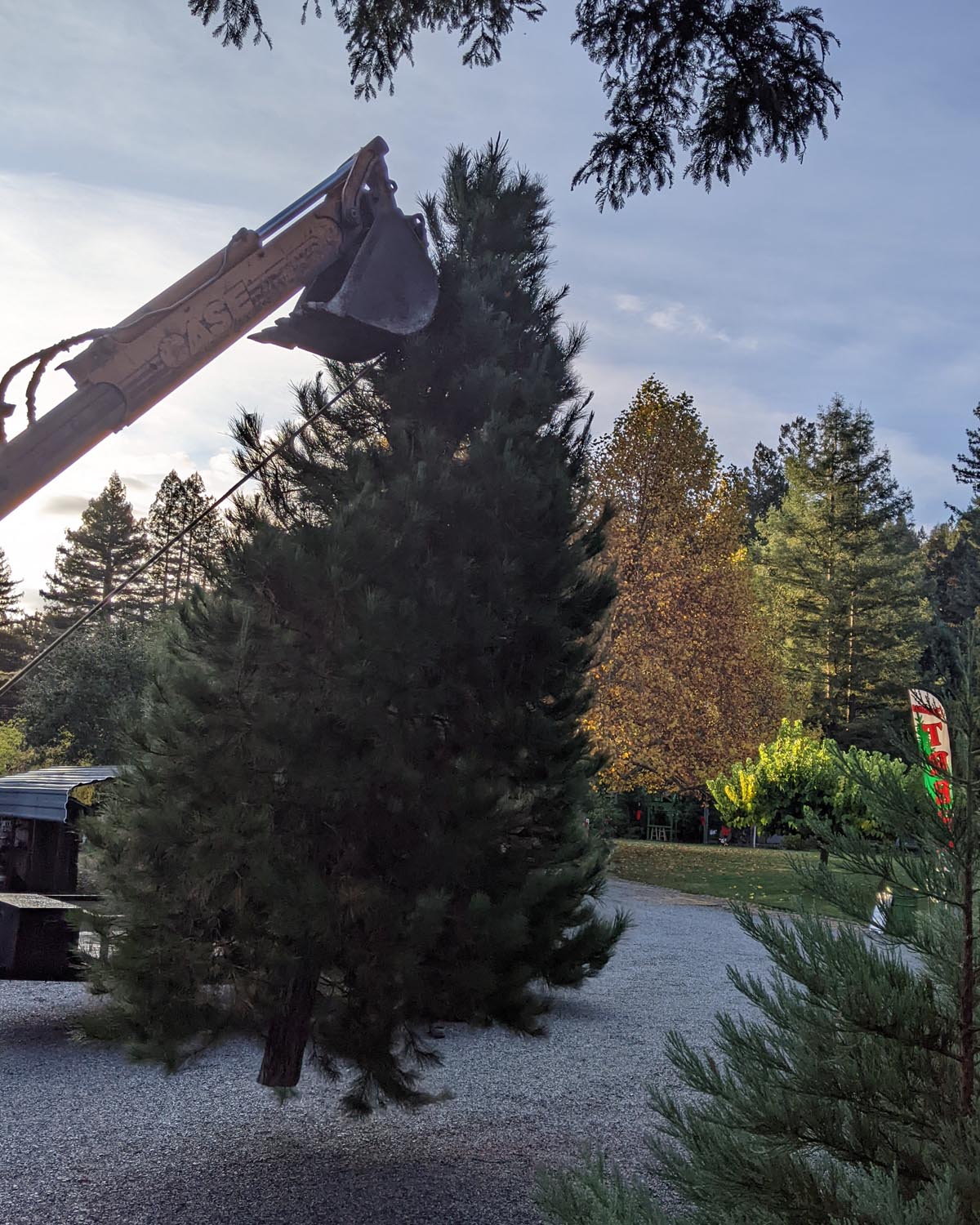
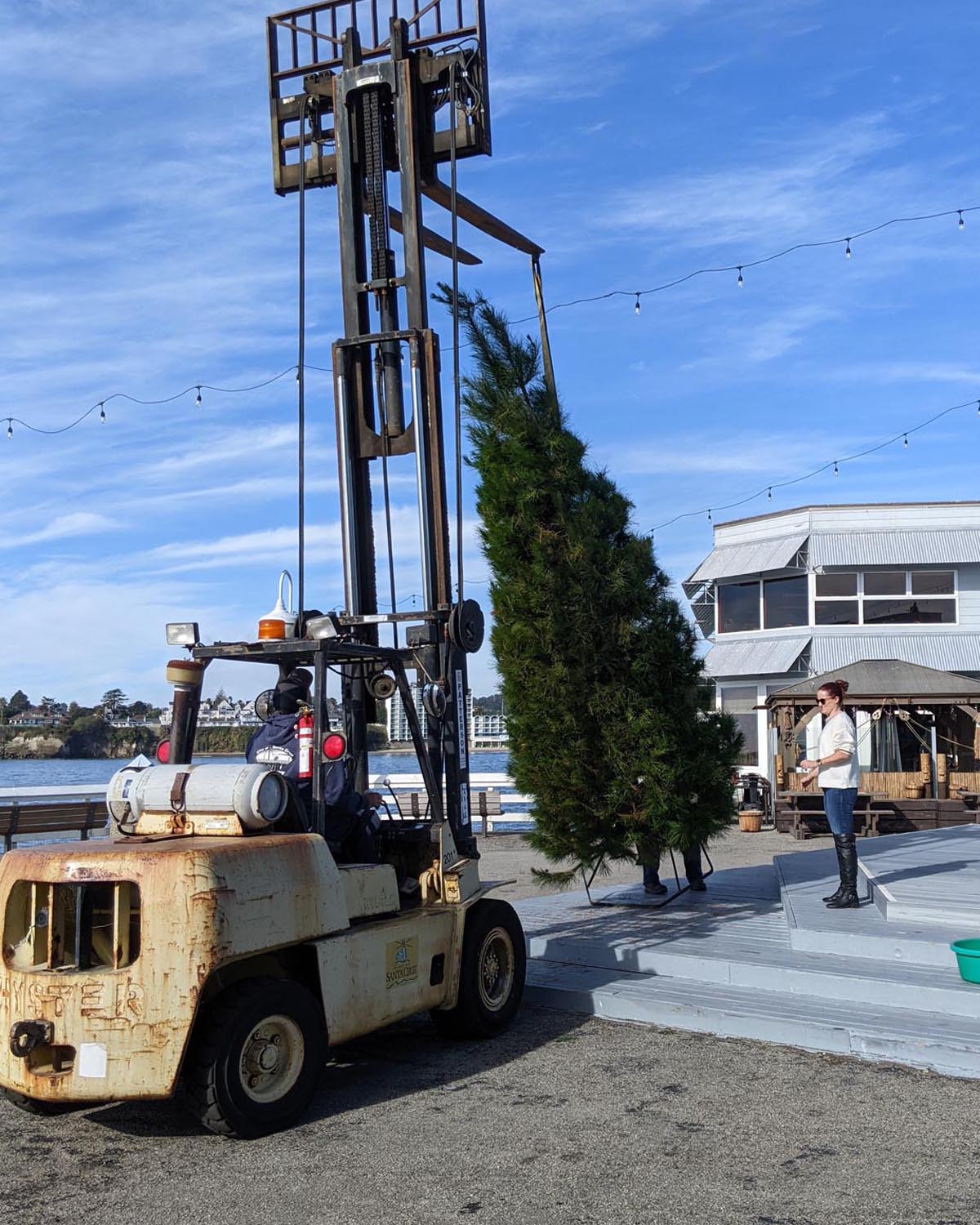
The Sierra Redwood is also the best choice for outside tall trees since the tops require no pruning, wind loading is good, and it holds up better against weather than most other varieties. Two guys can cut and load a 20-24 footer with a backhoe in under 30 minutes. There is probably more profit margin in the delivery and recycling than in the actual tree price.
- The local “Coast Redwood” (Sequoia sempervirens) is less popular because it requires multiple shearings and is less preferred by customers.
- The third of the species, the Metasequoia or dawn redwood, is native to China. We have a few at the other farm that I brought back from Hong Kong in my briefcase many years ago.
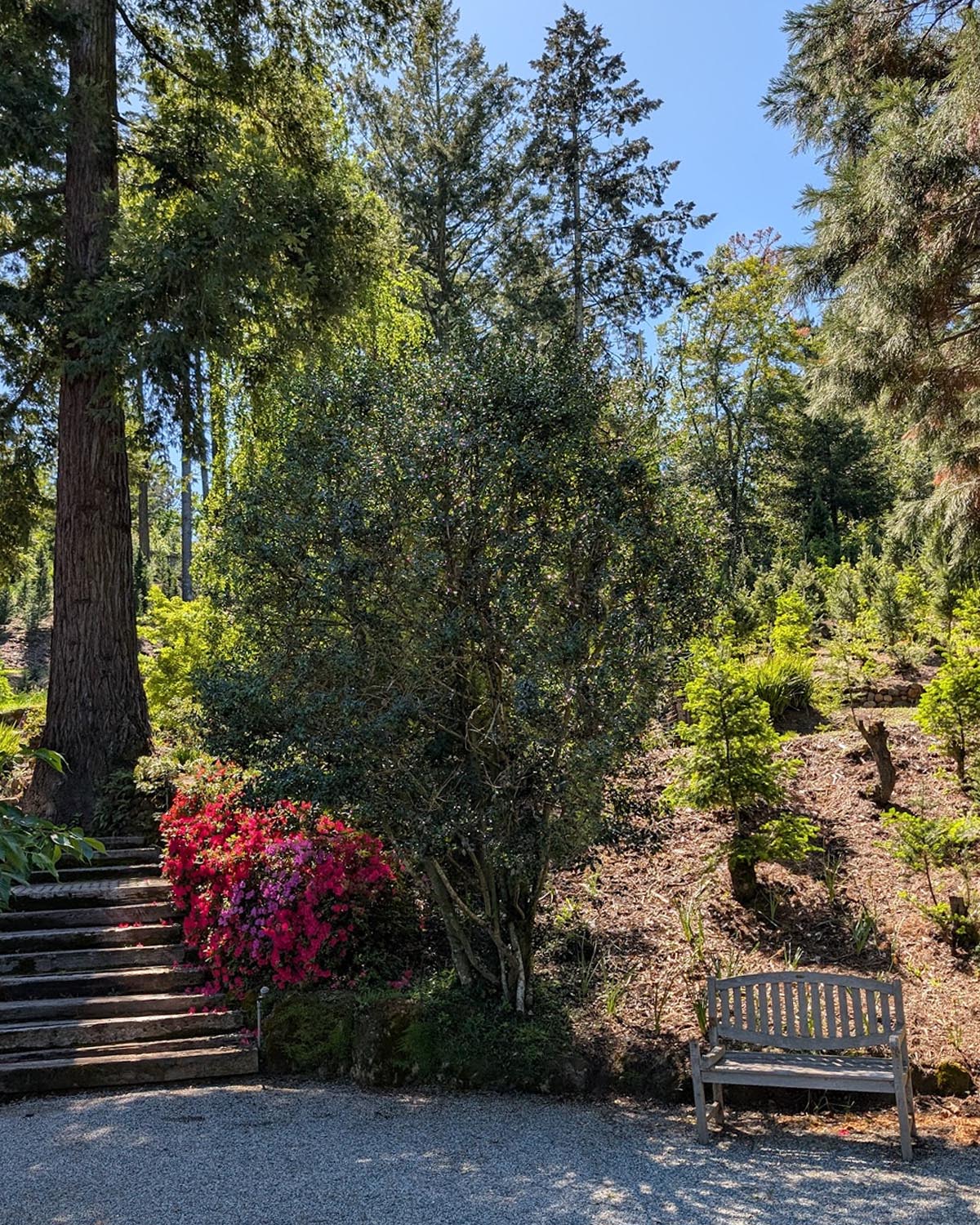
The prune tree next to the big Sierra Sequoia dates back a full century to when this area was covered with prune, pear, and apple orchards. The Holly tree is one of many used in our wreath-making. It is also sold, along with mistletoe, in the gift shop as individual sprigs with a colorful ribbon.
Back to Map

Pumpkin Patch
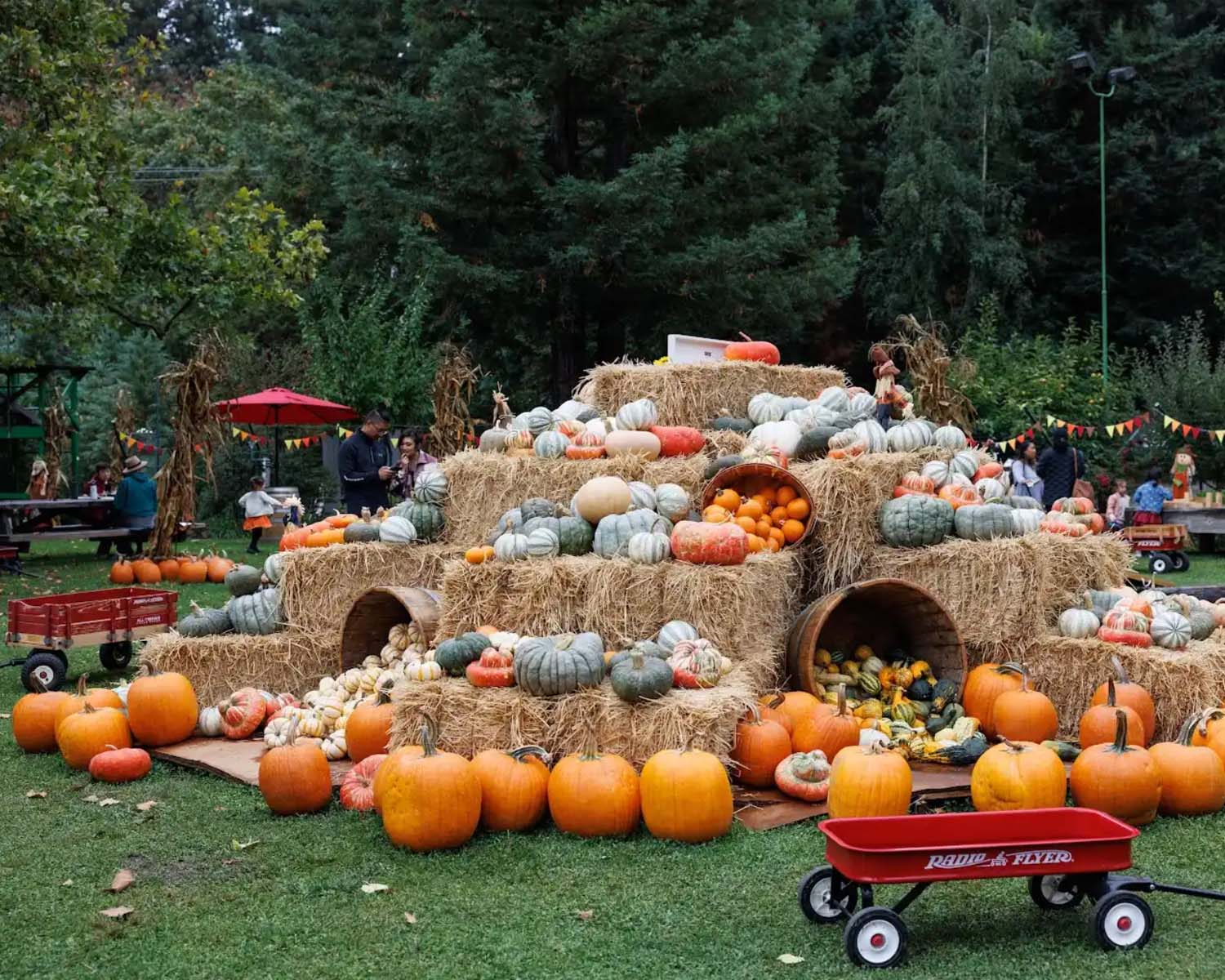
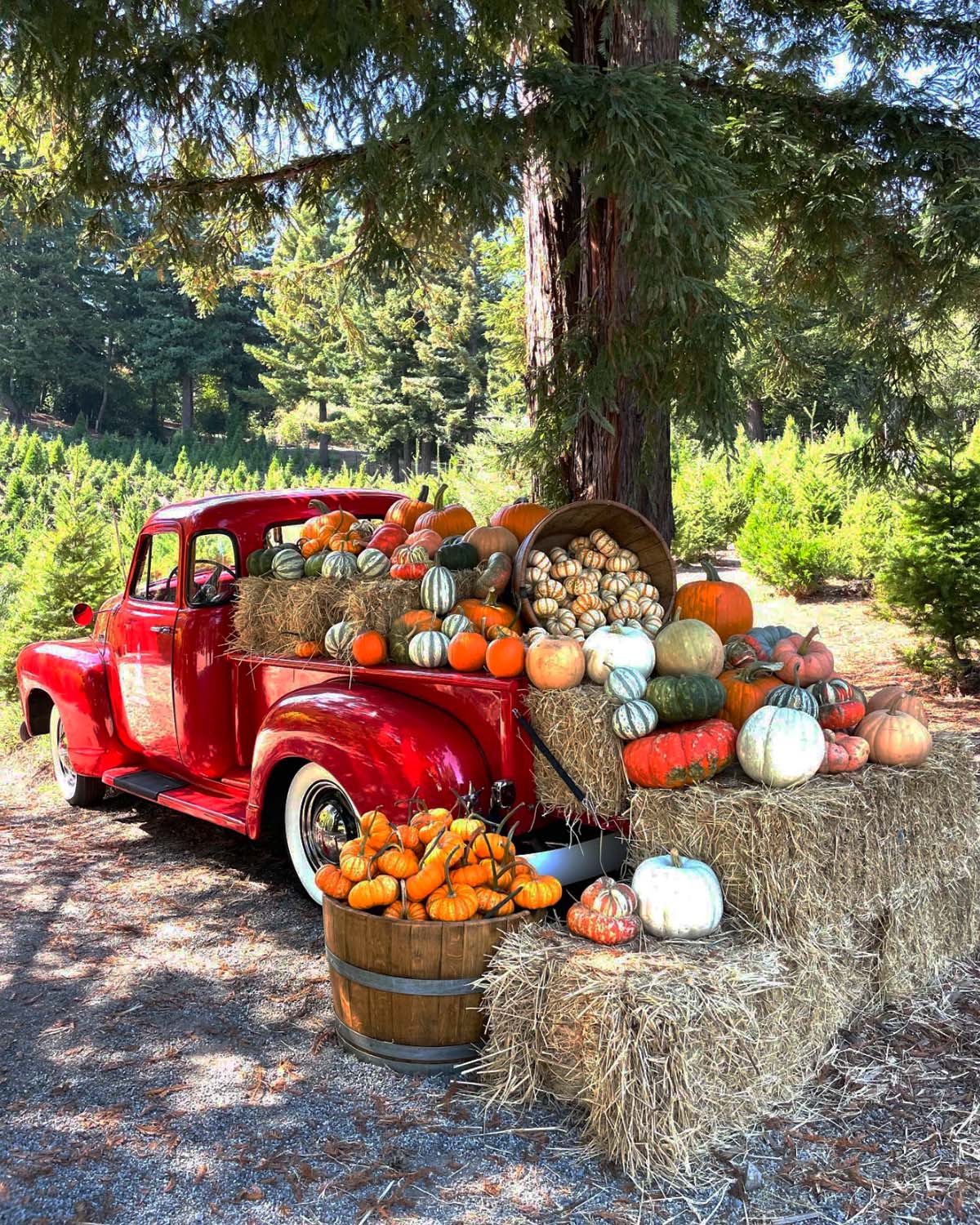
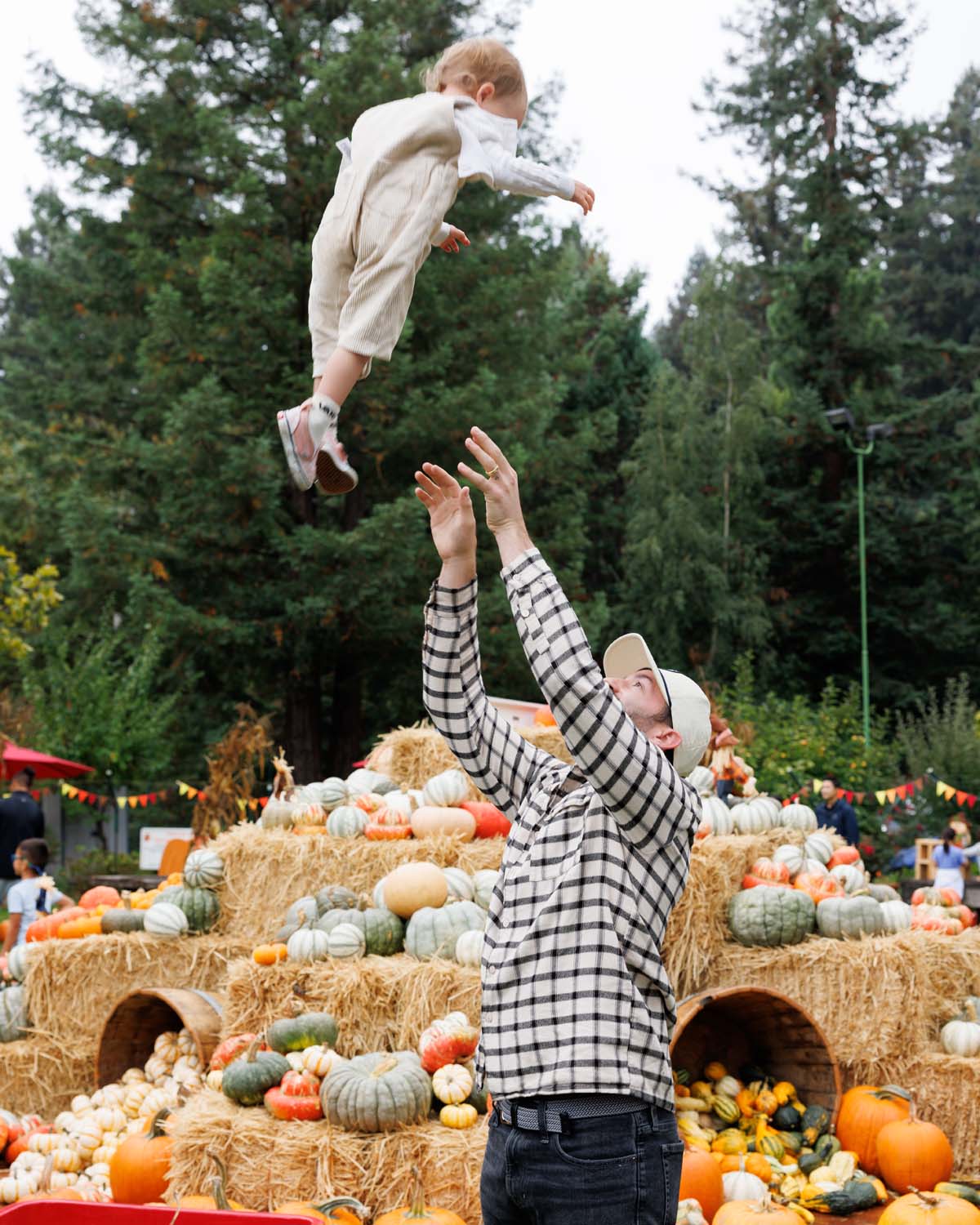
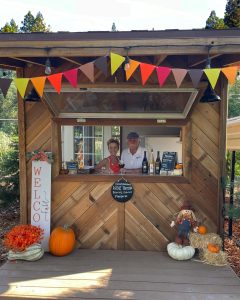 Who could have imagined that people would drive from San Jose to spend $20 for a pumpkin they could buy at Safeway for half the price? When my overgrown Christmas tree hobby outgrew my ability to deal with another business, Kelley took over and created an alternative to the typical pumpkin patch you might find in a vacant lot with a bouncy house and inflatable skeletons. The Half Moon Bay scene offers even more chaos, traffic, and overpriced pumpkins.
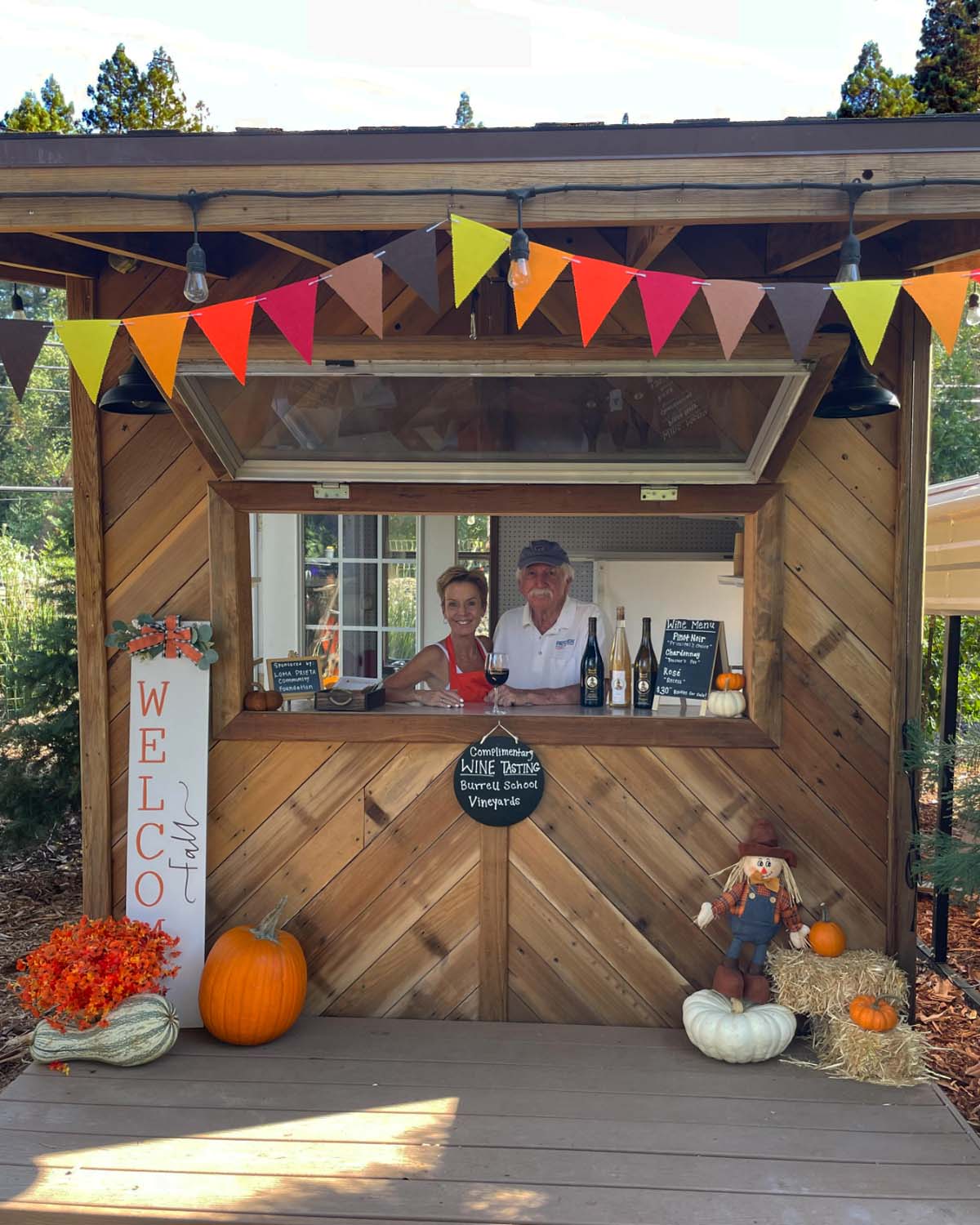
Patchen provides a taste of nature and the simple pleasures of lawn games, popcorn, and lemonade. Weekend evenings include wine by the glass from Burrell School winery, live music, and the best taco truck in California.
Back to Map
Reservoir
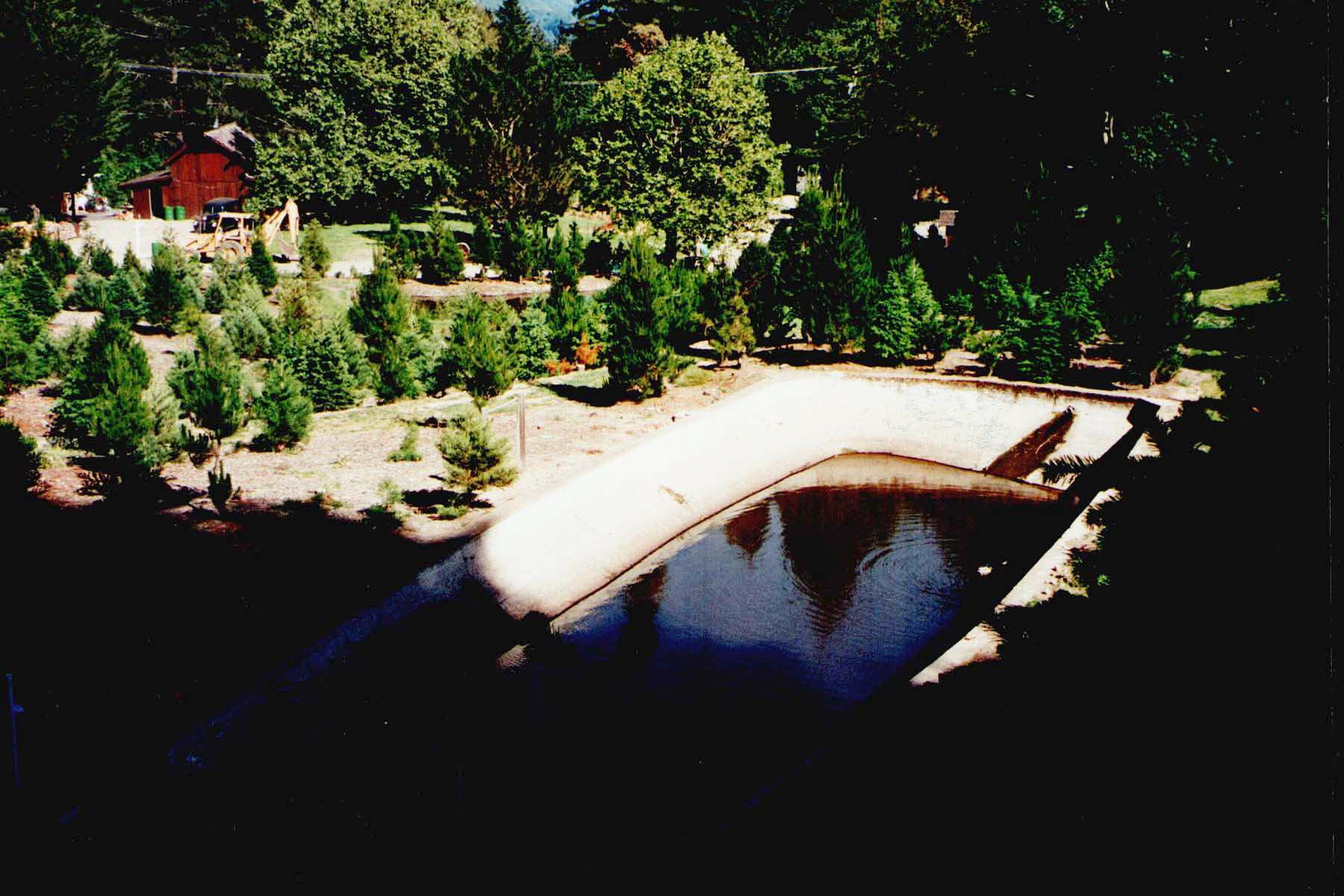
The water supply for the town of Patchen was a spring, connected via an underground redwood aqueduct to this concrete reservoir, which was probably constructed in the late 1860s or early 1870s. That was most likely when the two-story house was built, which would later become the first Post Office, and is now the Patchen Barn.
The Silver Dollar Eucalyptus at the east end provides branches annually for use in the wreath-making operation. The plum tree just across the path from it is what is known as a Myrobalan plum, or cherry plum, which was used as rootstock for the orchards that once covered this area. It is often referred to as a native wild plum, but while it is indeed wild, it came here originally from Eurasia.
The covered dry well at the west end of the reservoir is one of five dry reminders of the scarcity of water in these mountains. The overhead sprinklers are used after planting seedlings, or on really hot late summer days, but mostly they are for fire suppression.
Back to Map
Slide Area
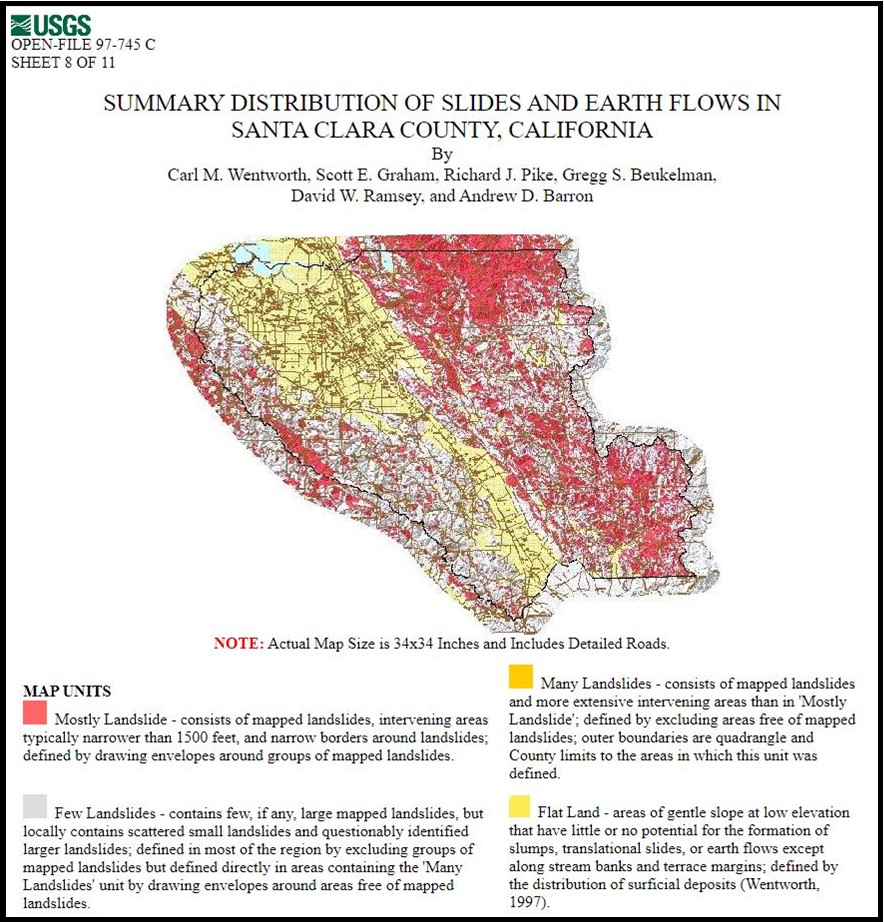
Geologists rely upon maps of where landslides have occurred in the past, and in this area, it is hard to put your finger anywhere on their maps without touching a slide. Looking uphill from here, we can see the profile of such a slide that occurred a few thousand years ago. The steep area below the scarp is shallow and riddled with broken sandstone, while the area below is made up of the aluvial that once was on the upper slope. Looking downhill from here, we can see what geologists sometimes refer to as a “lobe” of the slide, with the highway running along this side of it. The other side of the road is the steep “original” slope.
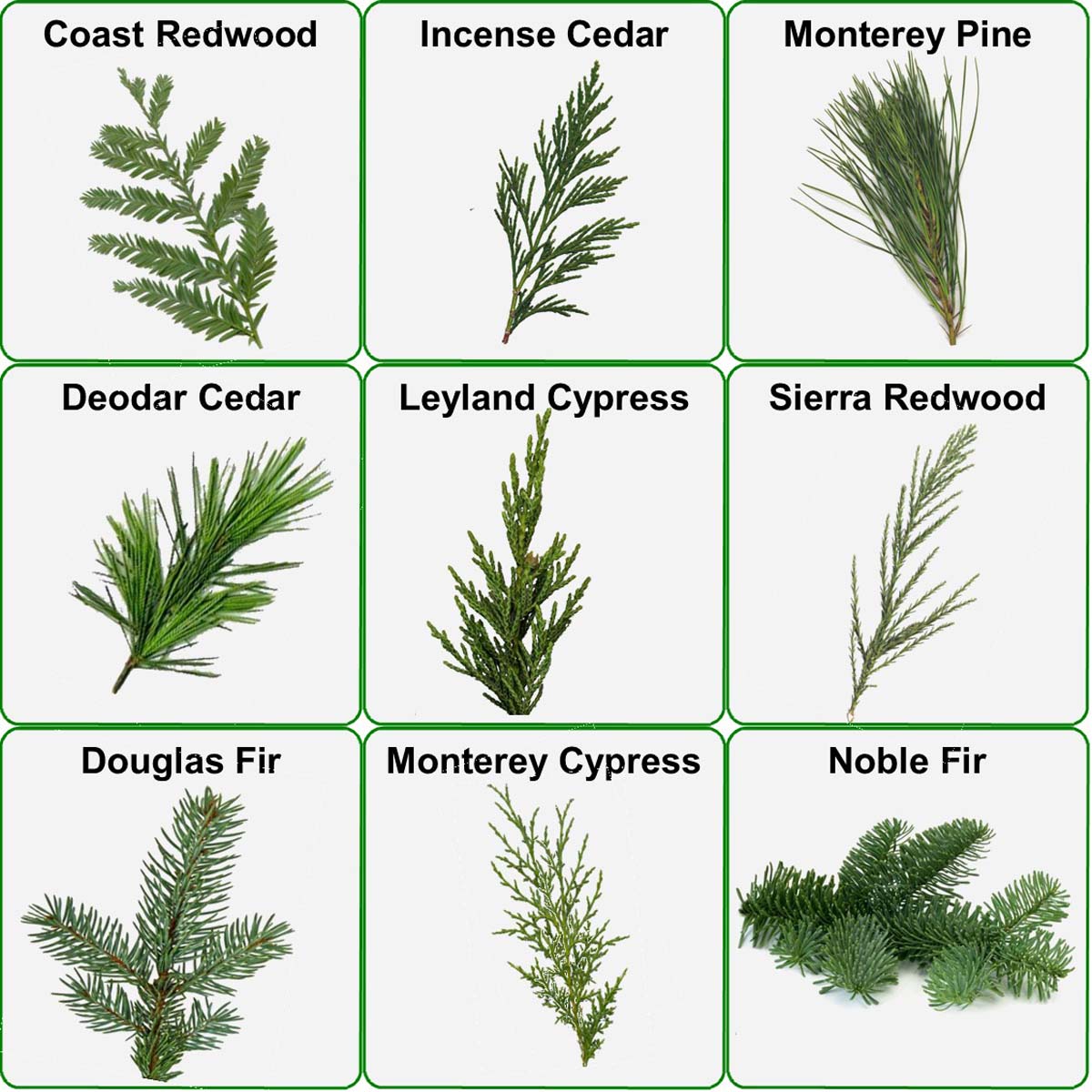
We have a half dozen or more species of trees under cultivation, the most popular being the Douglas fir (Pseudotsuga menziesii), which, of course, is not truly a fir. They do well in this climate, as they heavily populate the surrounding areas. They don’t naturally propagate by their own seed very well, but we always dig up and pot the rare volunteers that show up. Monterey pines are popular here, as are the Sierra Redwoods and, more recently, Incense Cedar, Leyland Cypress, and Monterey Cypress.
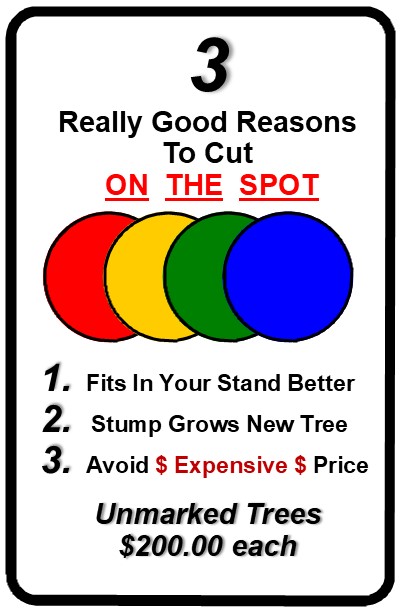
After a tree is harvested, we give it a year to recover before starting preparation for the next cycle. In the following year, a 6-12 inch “window” is established, with a handful of healthy branches below and the new tree above. By year 2 or 3, it’s time to select the best 2 or 3 candidate suckers. By year 4, the final selection is made, and the color spot is added about 6 inches below the bottom whorl. Customers are instructed to cut on the spot to ensure enough stem for the stand. Often, when a well-shaped tree doesn’t sell the first year, the window is raised enough to allow a second tree to emerge from the stump, to be used for either a pre-cut table-top tree or a headstand on the next cycle.
Weed control is essential for good tree health, but also to prevent customers from taking home bugs and spiders. It is done here primarily with woodchips renewed on a 3-year cycle, followed by touch-up with Roundup. It is critical to use no less than 2 inches and no more than 4 inches. Less than 2 inches doesn’t discourage all of the weeds, and more than 4 inches causes tree roots to turn up for moisture (particularly with pines). The added benefit of the woodchips is that (1) it holds moisture in the soil, (2) it returns nutrients to the soil with the natural decay, and (3) it provides a soft & clean place to kneel down for harvesting. Some reports suggest that this practice robs nitrogen from the soil, causing reduced leader growth. Our experience is exactly the opposite.
Back to Map
Woodshop
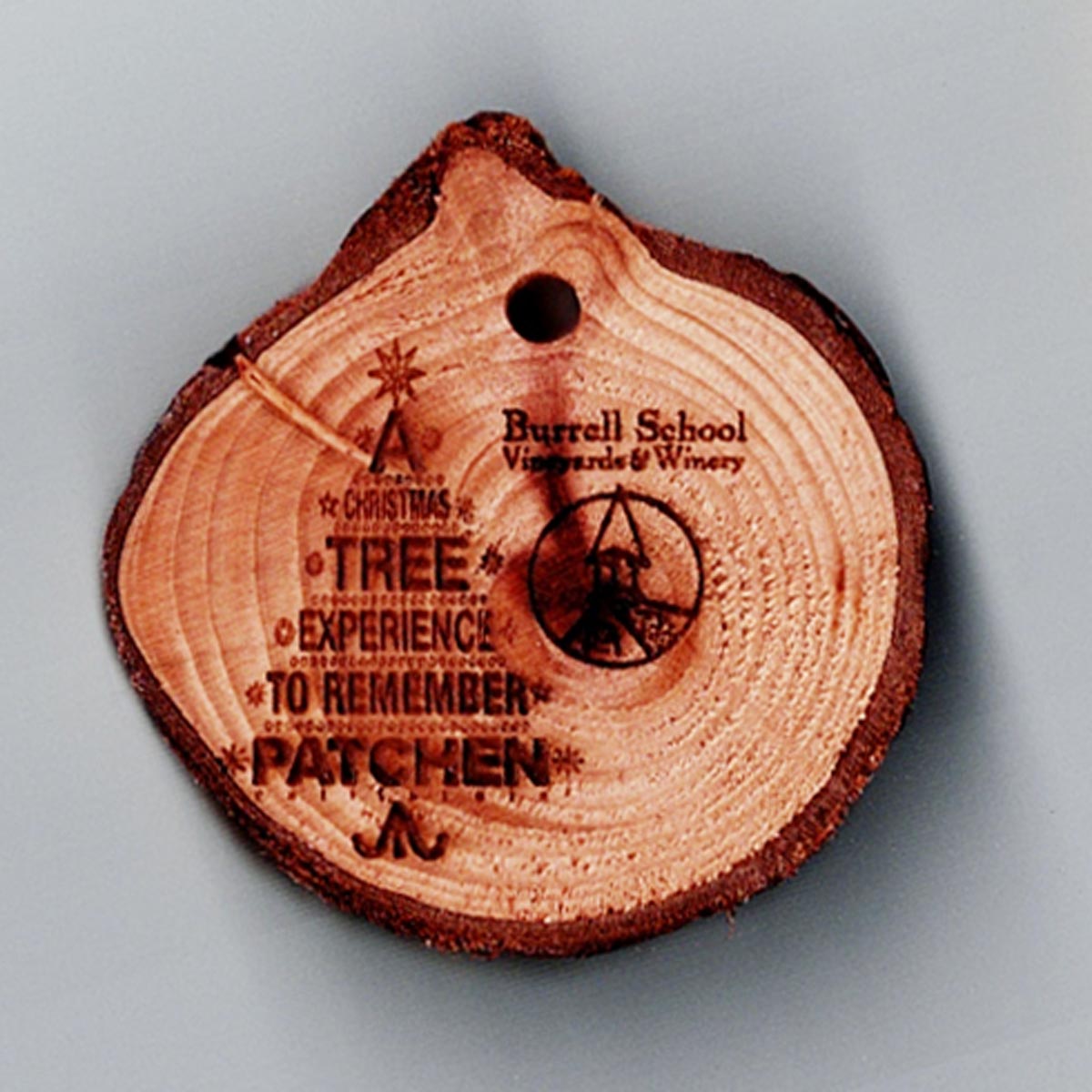
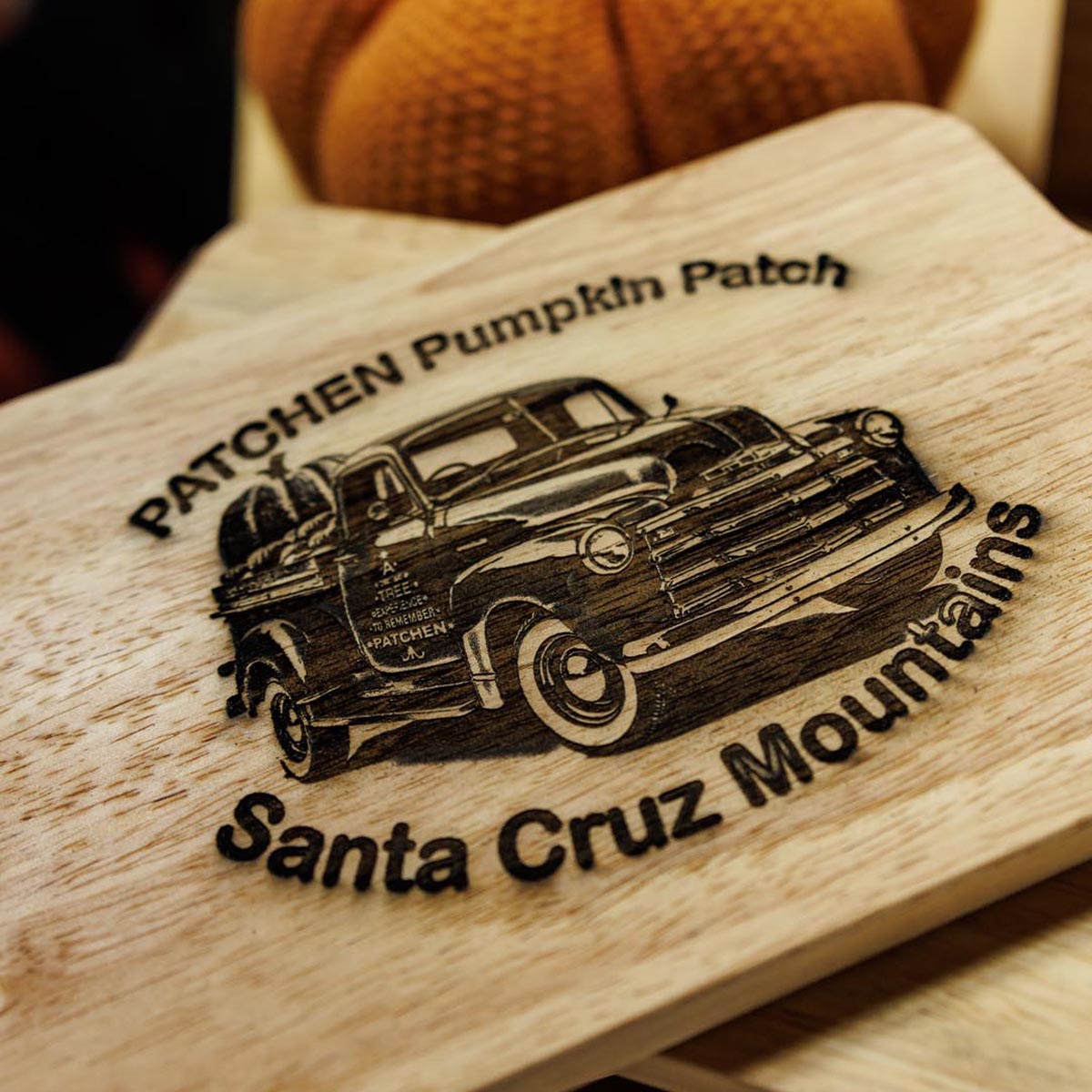
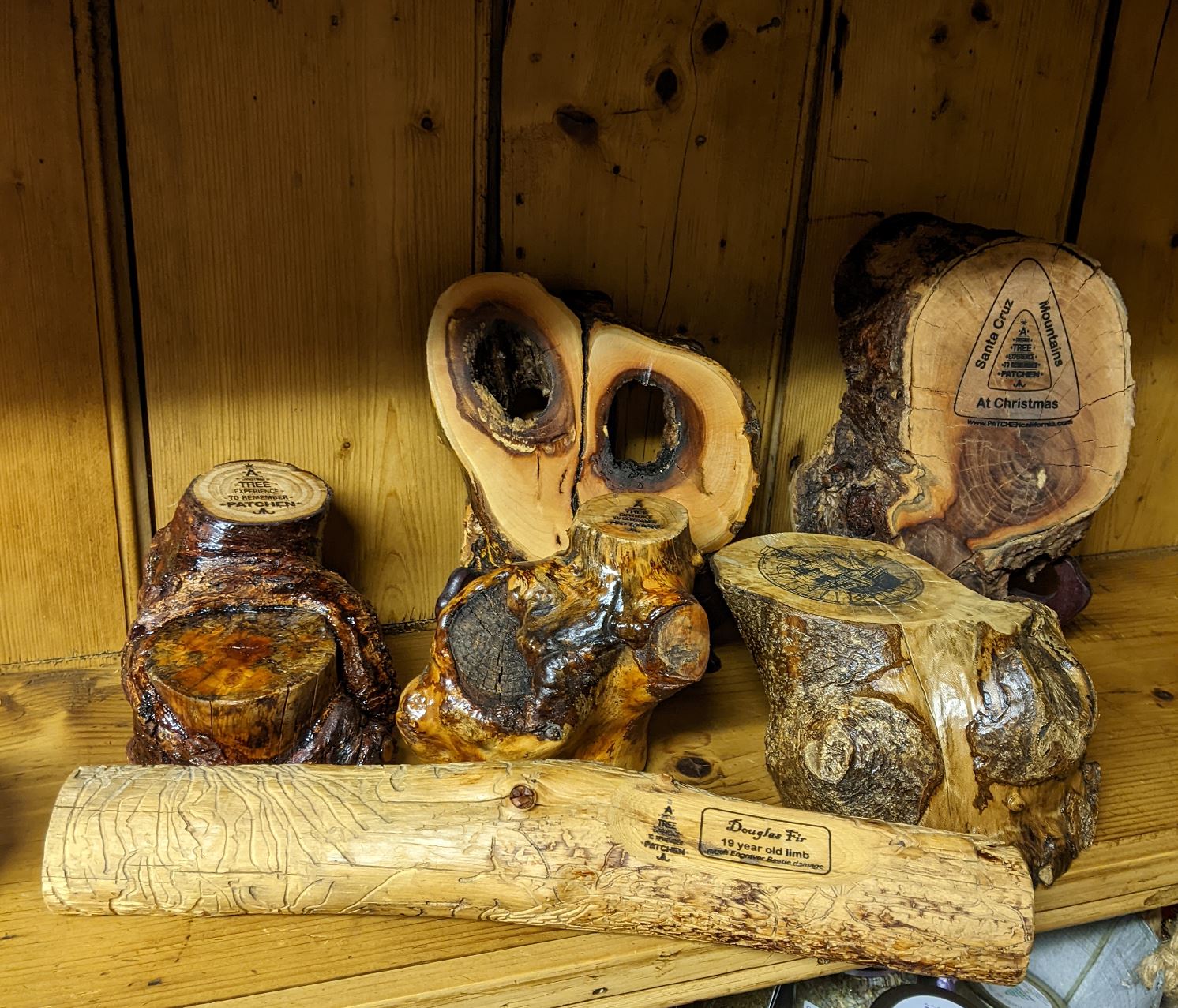
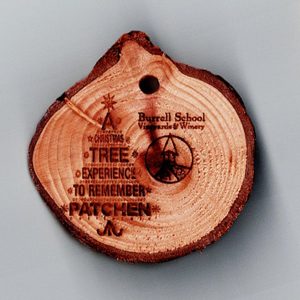 When we occasionally lose a tree to old age, we salvage the stump to cut into thin slices to be laser-engraved as tree ornaments. The smaller ones go through the drum sander before the laser treatment, while the larger ones are trued up using the router sled and orbital sander.
I am currently experimenting with microwave drying these “cookies” to minimize cracking. Paul Illingsworth is the expert in this area, so in the meantime, I fix the cracks by engraving a screw through them.
We custom-engrave these items when time allows. Anything (preferably wood) that will fit into a 15″ x 15″ x ~12″ volume can be custom engraved with text, pencil sketch, clip art, or photo in under an hour.
Back to Map
Post Office
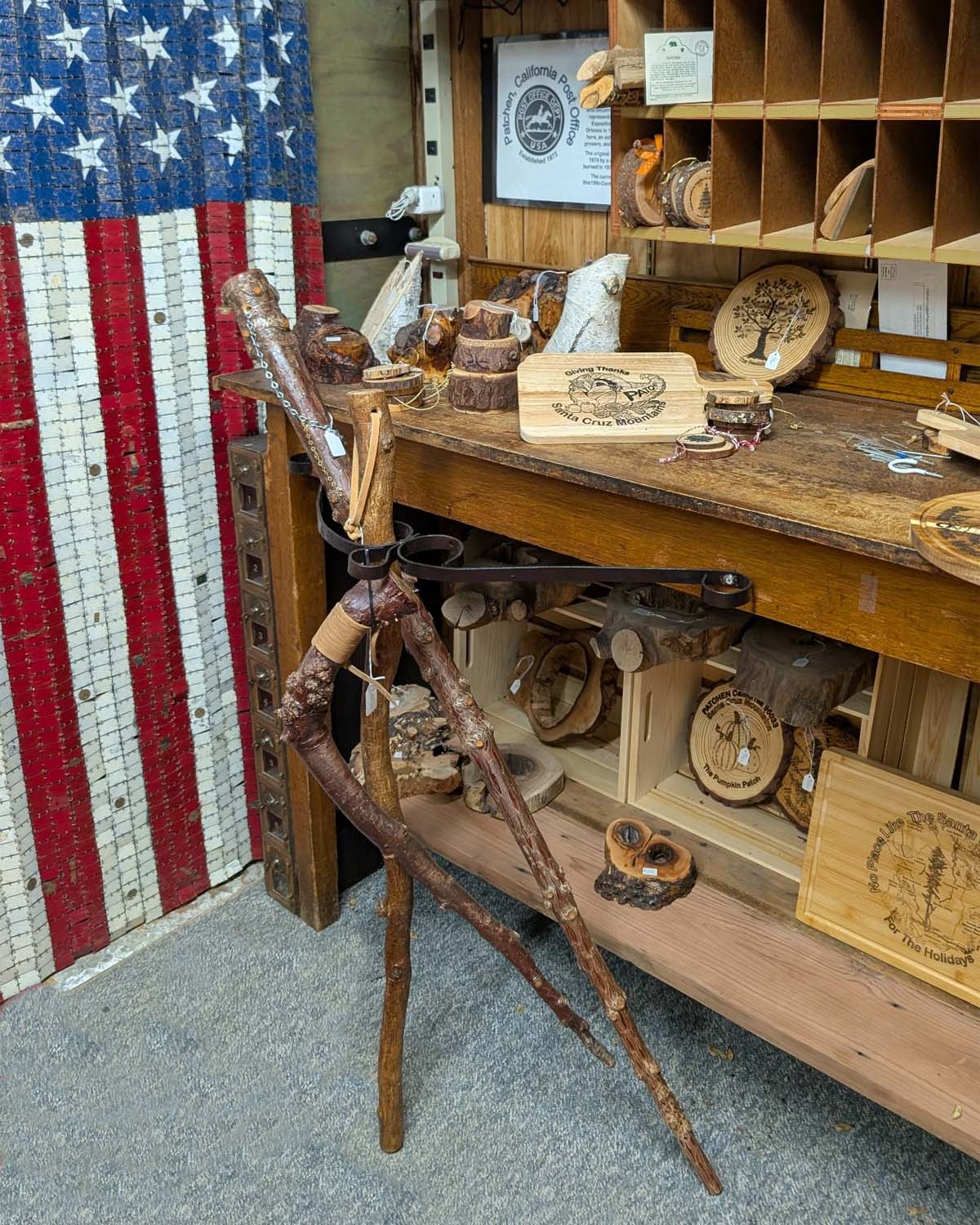
The Patchen, California Post Office was dedicated on this site on March 28, 1872, and the first Post Master was D.C. Feely, who we think lived in the two-story house where the barn is today. Two years later, the Post Office was moved from the house into a new building, the remains of which can be seen here, after the 1998 earthquake. In 1885, Feely represented Patchen at the American Exposition at New Orleans. He took a polished wood collection, a soil sample from this farm, and a large exhibit of fresh fruit provided by the local fruit growers.
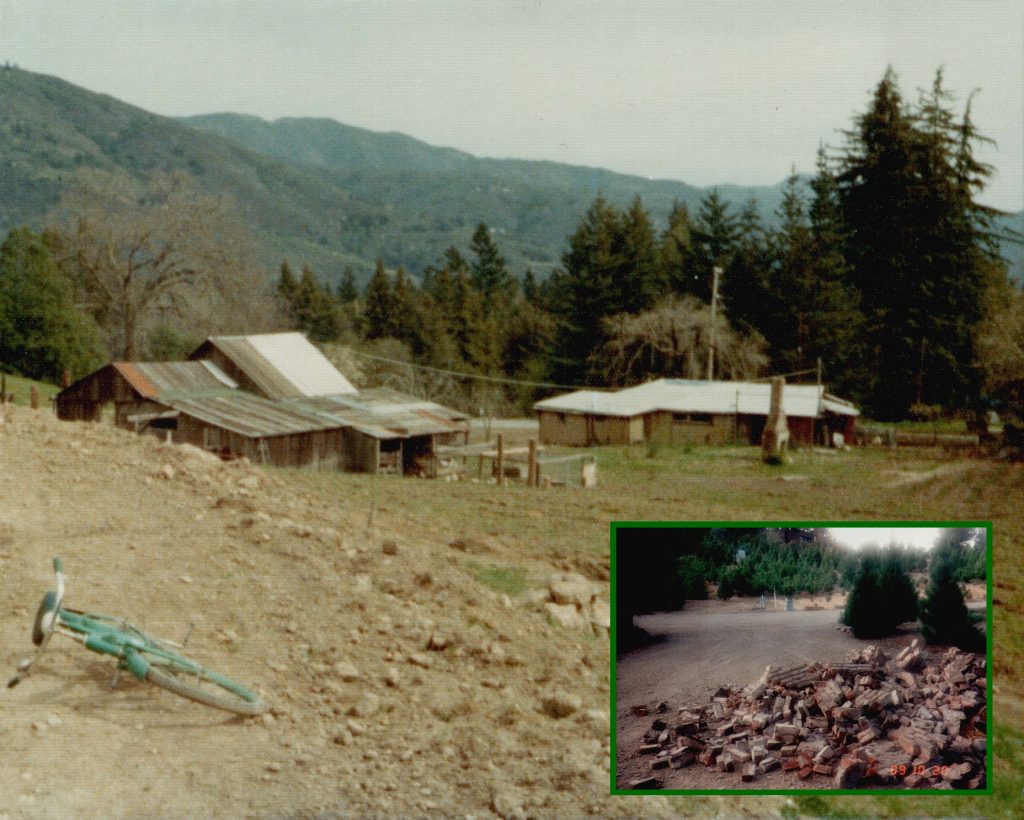
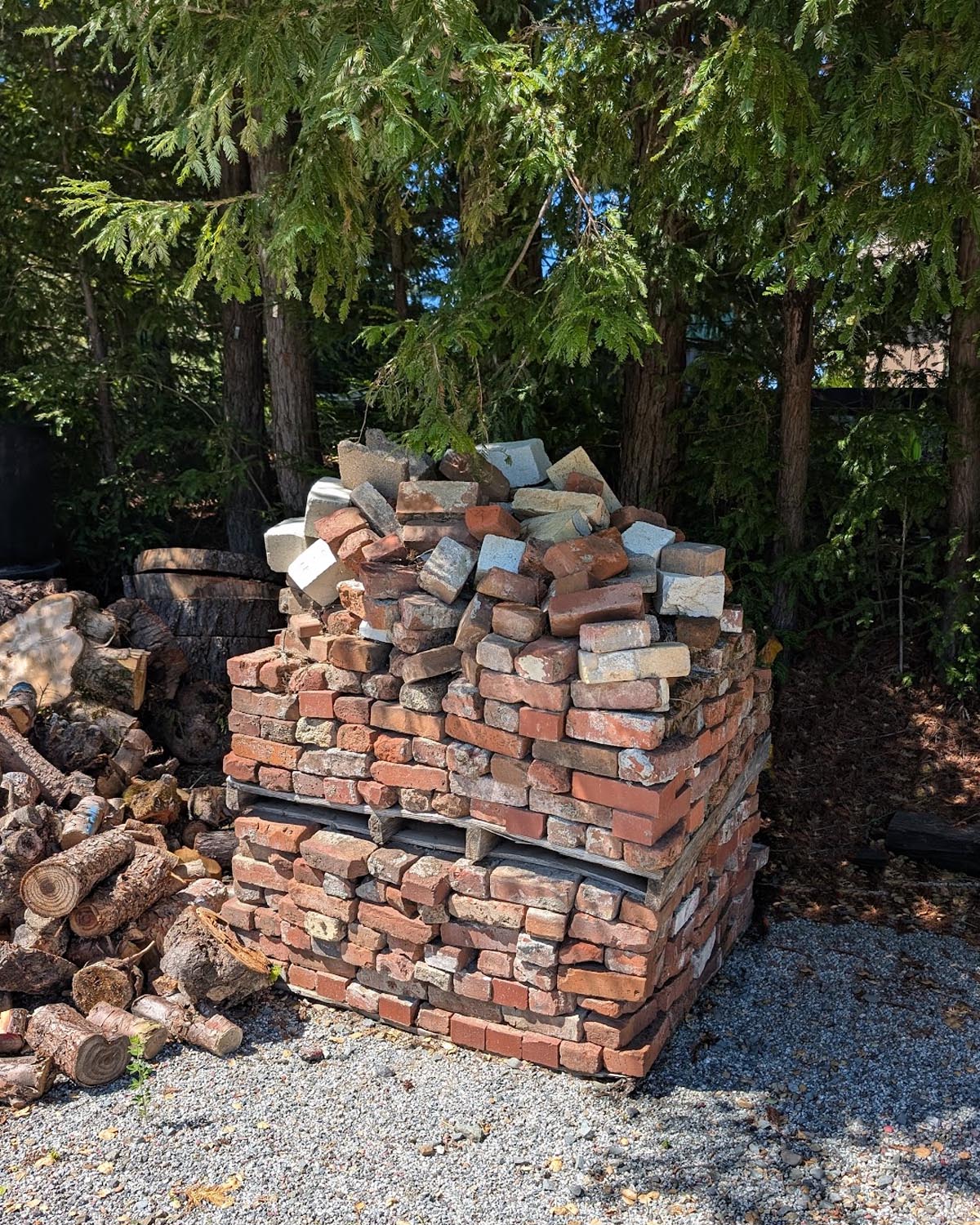
The “Castor Barn” link shows the original barn in the left-center and the smaller of the two “Laddick Houses” near the center of the frame behind the chimney of the Post Office – still standing in this 1973 photo. The main “Laddick House” had burned 15 years prior. The inset shows the remains of the chimney after the 1989 earthquake and the bricks that fell that day, which we still have waiting to be rebuilt.
Back to Map
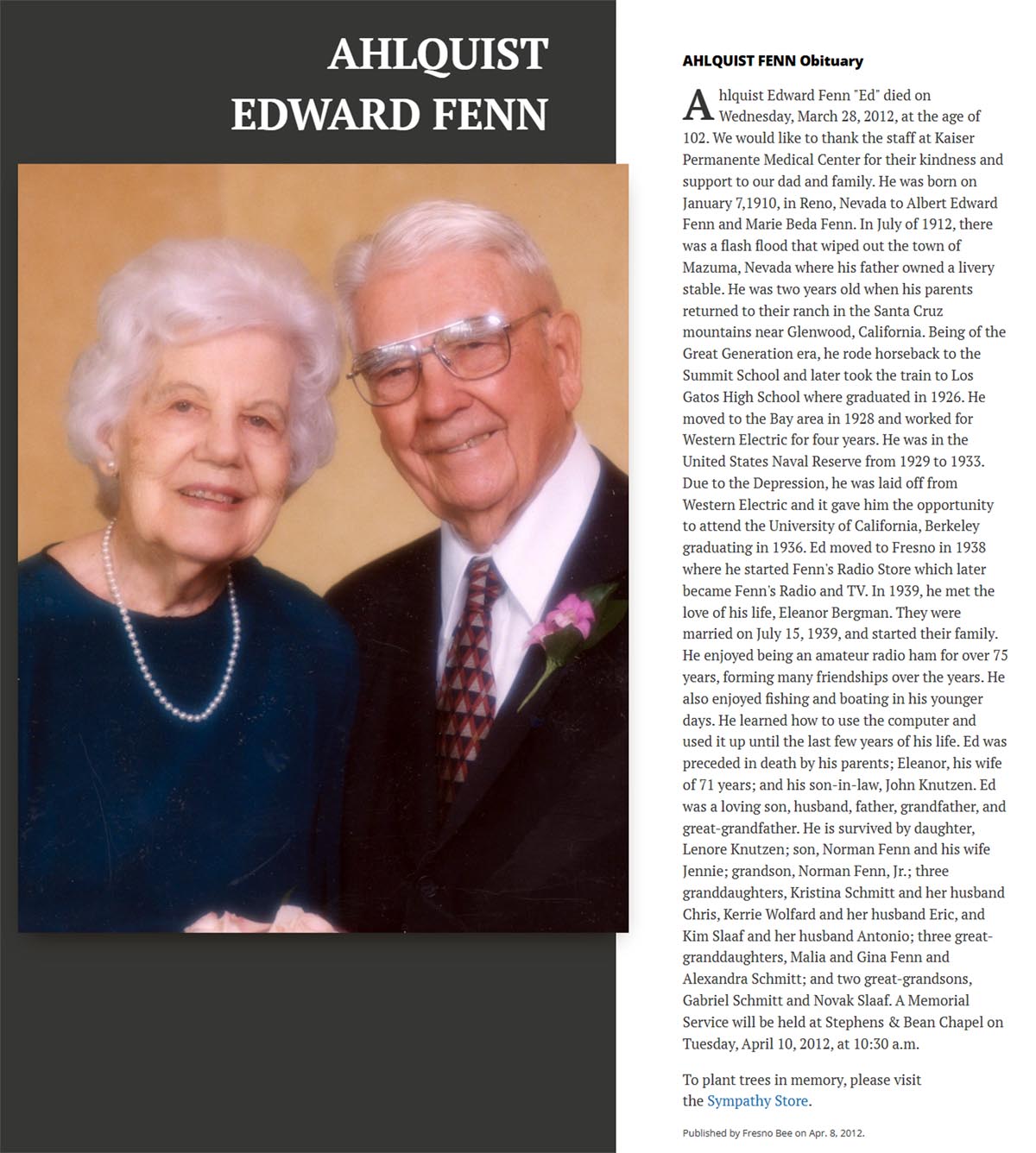
Alquist Edward Fenn
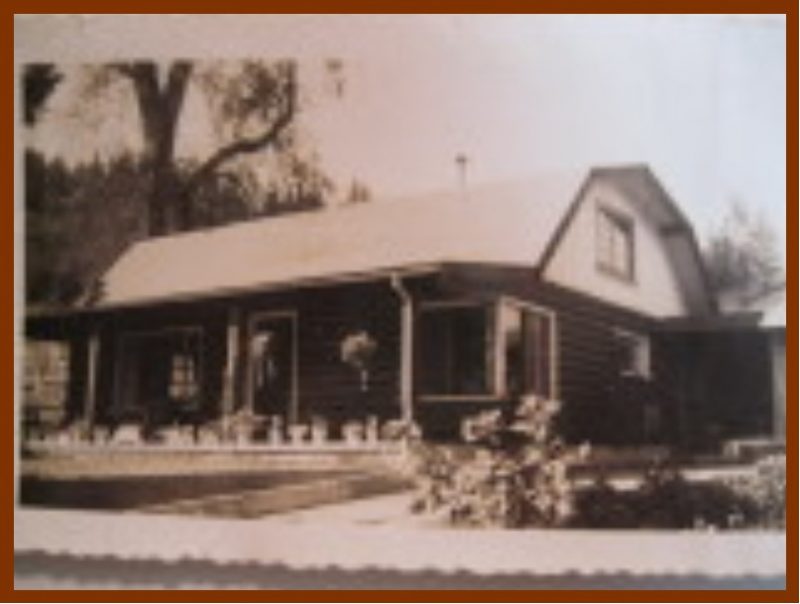
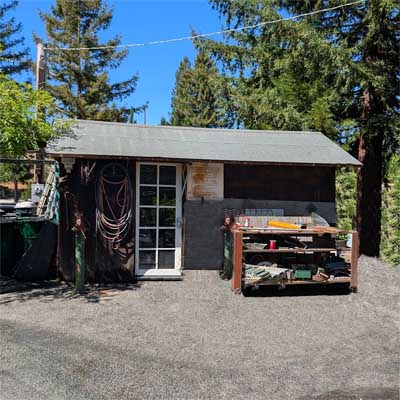
Some years ago, we enjoyed a visit from a 102-year-old man named Ed Fenn, who at the age of 13 years lived in what is now a workshop (a house in 1923), pictured here. That was the building referred to as the smaller of the two “Laddick Houses” in the above photo. We listened as he described his memories of growing up in these mountains and of Harry Ryan and others who had been legendary pioneers in this area.
He confirmed for us that there were at least three buildings on the property at that time. The Post Office building, the two-story house that had previously been the Post Office, and the house where he stayed. Two of those buildings burned to the ground in 1958, but the smaller house survived. He was not sure about whether what we call the Castor Barn was there at the time.
A video documentary of his visit and remembrances is pending, and will be added to this site when available.
Back to Map
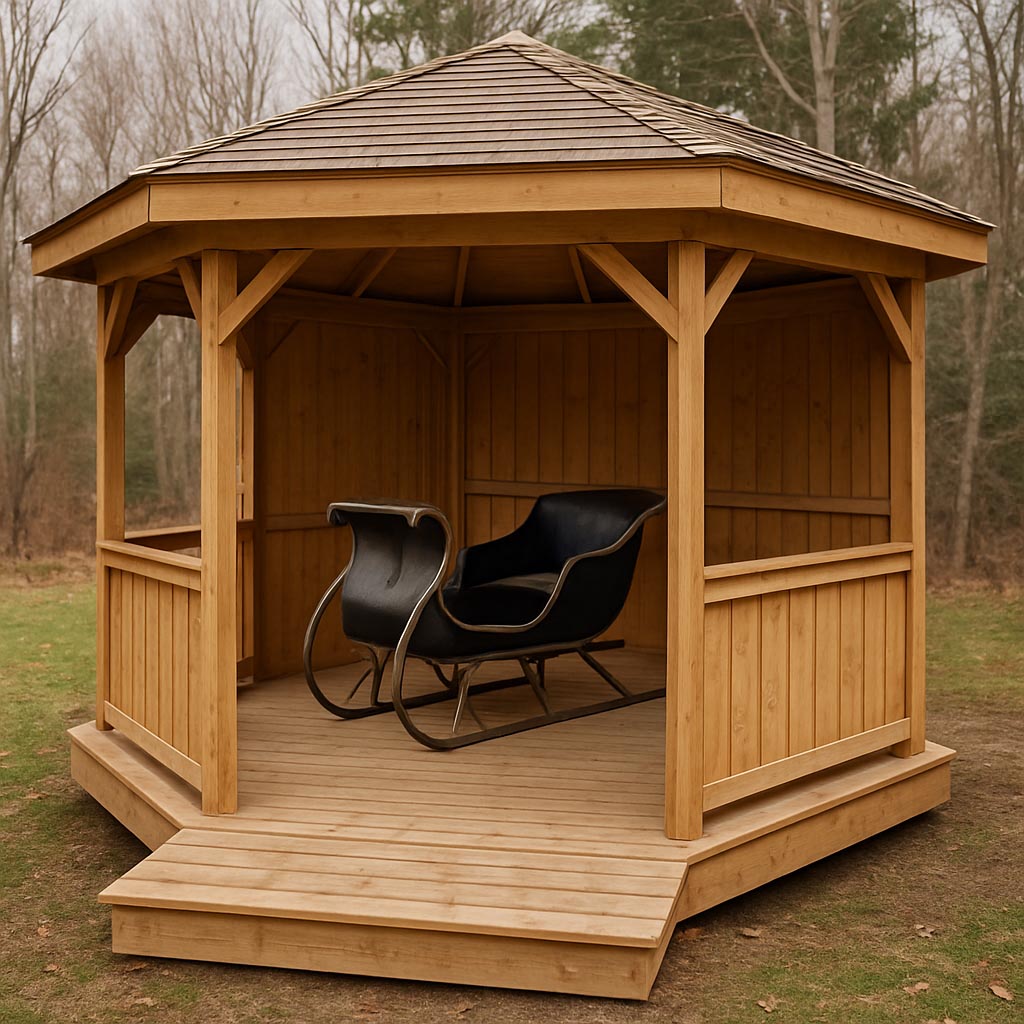
The Sleigh
We visited Joe McNally and Ann Benoit, who had a Christmas tree farm in Paradise, California, for a weekend at a time when they were considering discontinuing that business. Joe had suffered an accident that limited his ability to do much of the farm choirs and Ann was tiring of the responsibilities. We bought several farm-related things from them, including this sleigh, built in Denmark, probably in the mid to late 1700s, and hauled it home on the back of my truck.
A few weeks later, fire swept through Paradise, destroying their farm with all its trees and buildings, including their recently remodeled home. Had it not been for our timely visit, this beautiful 300-year-old treasure would have been lost forever.
Back to Map
“THE” Barn
Patchen’s Nerve Center
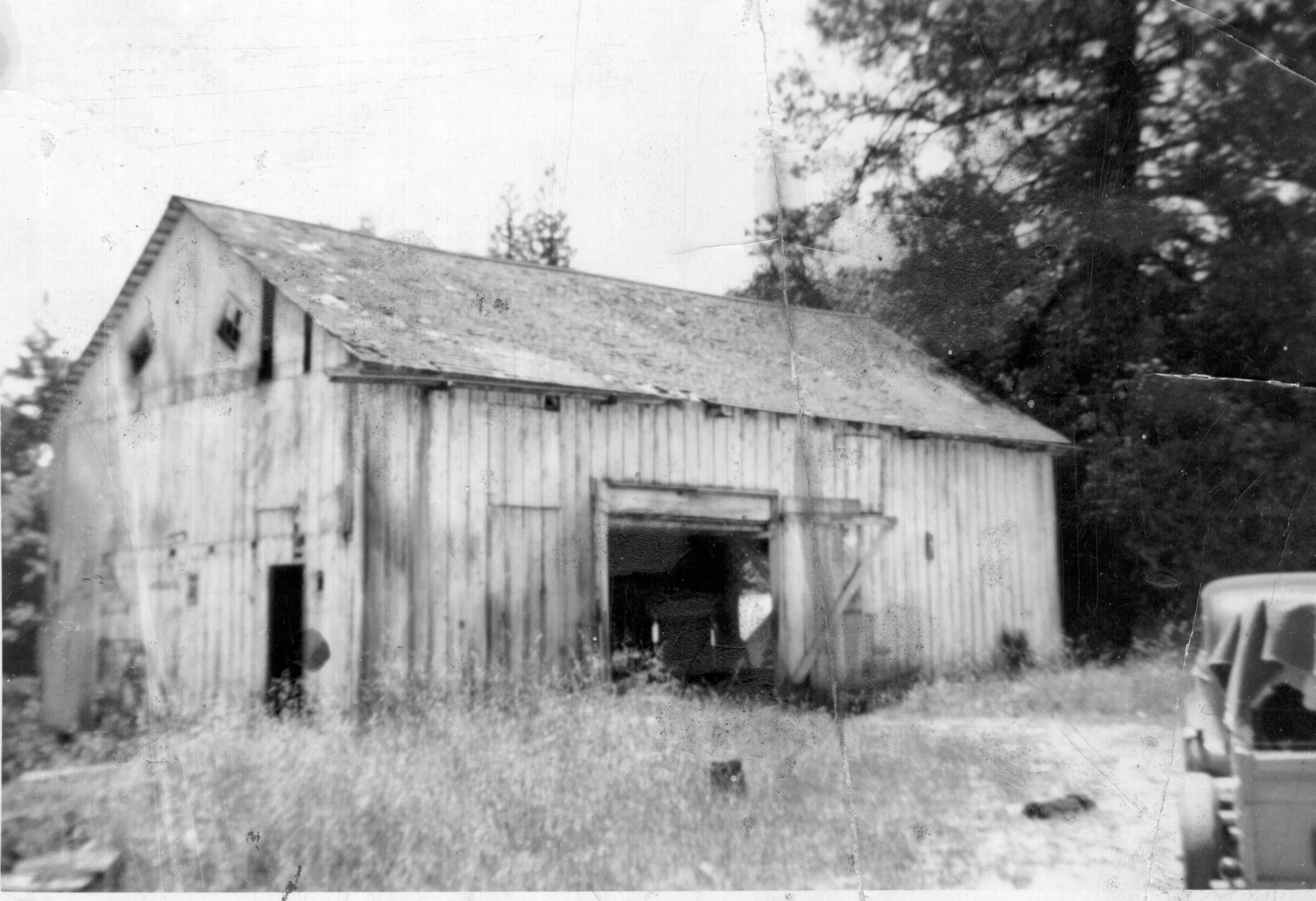
What I sometimes refer to as “The Castor Barn” was originally located 50 yards to the northwest of where it stands today. It was probably built in the 1870s, but no one knows for sure. In any case, when I bought the property in 1972, it was in pretty bad shape, having been originally thrown together from rough-sawn redwood with no foundation and a half-blown-away sheet-metal roof.
Before “Grandpa Castor” (as the neighbors called him) died, he lived in the small house where Ed Fenn had stayed 50 years earlier. The concrete perimeter foundation of the two-story house next to it remained after the 1958 fire. So in the mid 1980s, I poured it full of fresh concrete and dismantled the old barn one board at a time to reconstruct on the resurrected foundation. I framed it with a chainsaw, using hot-dipped 16-penny nails and rough redwood from a scrap yard in Santa Cruz.
I added the interior walls in the late 1980s in anticipation of starting the WeedSeeker business there.
Gift Shop
This combination Gift Shop and Cashier stand features wreaths, garland, table-top trees, living trees, and a wide range of gift items, all of which are either made at Patchen or in the local area. We like to say that nothing sold here was made in China, but occasionally something slips in.
In recent years, we have been finding it increasingly difficult to make a profit on wreaths. In the distant past, we made them from scratch, but soon converted to buying bare Noble ones from Oregon to decorate here. Our selling prices have not kept up with the labor cost increase, and we are questioning whether the market will accept additional price increases.
TreeFreshᵀᴹ Products
The undeniable drawbacks to displaying a REAL Christmas tree in your home include needles in the carpet, water spillage, a leaking stand staining hardwood floors, fire hazard from premature drying, just to name a few. I call those things the 12 hassles of Christmas, and I have developed 4 products to minimize their hassles. All four are offered at our farms, and 3 are available online at wholesale prices – OldSummit.com. We have not promoted that business in recent years, in order to focus on expanding into pumpkins, etc, so the prices are likely out of date.
The WeedSeekerTM
In the early 1990s, I developed a technology and two products, which I sold mostly for weed control in orchards, vineyards, roadsides, and railroads. After four years, I sold the Company to John Deere, and after being resold multiple times, the original WeedSeeker is still available today. So if your Christmas trees are planted in rows, this selective spraying technique might be of interest.
Back to Map
A Final Note – Retailing 101
Prudent minds often differ on such things as retail strategies in these days of social media, AI, and the rest, but I think most professionals would agree that the most important elements never change.