
Kokomo
April 1965
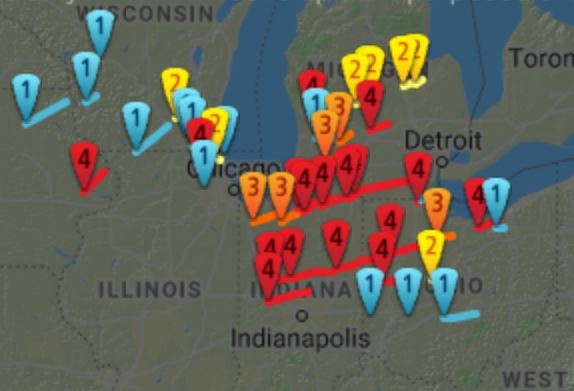
It was Palm Sunday, and it was hot. The humidity was as close to 100% as it can be without raining. This is the time of year when warm air rushes up the Mississippi Valley from the Gulf of Mexico until it hits cold air from Canada – then all hell breaks loose. They call it tornado alley for good reason. The red flags on this map with “4” in them indicate where category 4 tornadoes touched down that night, right where I lived and worked.
I was returning home to Kokomo from a weekend in Angola, where a year or so earlier, I had graduated a second time – this time from business school. By the time I passed Fort Wayne, darkness was approaching, and I could sense it was going to rain, so I pulled off the highway to put up the top on my red, 1963 Chevrolet convertible.
I hesitated for a few minutes to take a closer look at the sky because the radio had been telling me to expect tornadoes. There was enough light to see clearly across the thousands of acres of cornfields in every direction, still covered with last year’s stubble and too wet to plow. Above that was a narrow band of light in the south and west, where the sun was rapidly dipping toward the horizon. Above that band of light was nothing but solid black. Every few seconds, I could see a bulge develop from one of the black clouds, and a narrow funnel would shoot down to the ground. These were not my first tornadoes, but I could see they were headed straight toward my home in Kokomo.

This is not an actual picture taken at the time, but it shows exactly what that night looked like. My Argus C3, probably loaded with 36 frames of Kodachrome, was next to me, but it never occurred to me to take even a single picture.
I had been through a tornado as a kid when one tore off part of the roof of our house at the Lake. I have also been close enough to others to hear that deafening roar, but I had never seen anything like this. “Real” Midwesterners will tell you that when you think one is coming, you rush to the basement – yes, houses in the Midwest have basements. Then go to the southwest corner, facing the wall, and bend over to put your head between your legs and, “kiss your ass goodbye”.
Ordinarily, when approaching Kokomo across the flattest farmland in the Country, I would be able to see the dim glow of city street lights from miles away. Tonight, the sky looked like a circus had come to town. When I hit the US-31 bypass, I could see that what earlier had looked like carnival lights were the lights of fire engines, police cars, and ambulances, racing in every direction. Everything was wet from rain, making the streets and vehicles reflect the flashing lights, and it seemed like trouble was coming from every direction.
I wanted to get home to my little 30-foot mobile home near Russiaville, a couple of miles from Kokomo, next to a little creek and surrounded by oak and hickory trees. US-31 was not the freeway it is today. As I recall, there was only one traffic light, and I think that was at the corner of State Road 22, which ran through the center of town. The traffic light was dark, of course, but there were enough emergency vehicles around that I could see well enough to get through the intersection. I passed the Delco Radio building, where I worked, and it was totally dark, as was the Chrysler transmission plant across the road.

These recent photos serve as a reminder of why it is such an easy place to forget – the exception, of course, being for those fond of tornadoes, snowstorms, and union bosses.
When I finally got to where my mobile home had been, there was nothing – no bushes in the front yard, no trees, no mobile home. Everything I owned, except what I had in the trunk of my car, was scattered over Ohio and East Central Indiana, never to be seen again.
I had noticed as I passed by the Holiday Inn on the US-31 bypass that there were lights inside. Having nowhere else to go, I returned to find all the rooms taken, of course, and a couple of dozen locals lingering around the lobby. Some were frantically waving their hands and crying, while others just sat quietly on the floor, staring into space and smoking cigarettes. One hysterical lady was loudly questioning how God could have done this to her, and a couple of others were arguing about who had lost the most belongings.
I remembered that I had a nice scotch plaid wool “football blanket” in my car. For those not from the Midwest, a “football blanket’ is not a blanket with a picture of your favorite football hero on it. It’s a real blanket that comes in a pillow-like carrying case with a handle. You sit on it during the game, and when it snows, you take out the blanket to put over you. It was still early, but I found a quiet corner in the lobby with my “football blanket” until the sun came up.
I had fueled up in Angola the previous day, so I had enough gas to get back to Fort Wayne, where the radio was saying there were service stations open. The next stop was Angola, then on to my parents’ place at the Lake in Three Rivers for a brief visit, before venturing on to California. I had been planning that move for a while, and the tornadoes firmed up my plans and adjusted the timetable a bit.