
Vestibule
It is remarkable that people are able to stand erect and walk around here on Earth without falling over. Imagine trying to balance a 150-pound sack of potatoes on two mop handles! It is possible for humans because their brains have control of dozens of muscle groups that it can call on spontaneously and totally outside our conscious awareness.
But how does the brain know which muscles to engage and when? It takes an infant several months to figure out how to stand up and walk. It took engineers decades to come up with the sensors, electro-mechanical actuators, and computer software to make a robot handle the task. The miracle of the human brain is in constant contact with several sources of data, three of which stand out as the most important.
- Eyes keep us aware of our surroundings and inform the brain as to both vertical and horizontal orientation. If we see a row of telephone poles and one is crooked, the brain says, “humm, that one is probably crooked,” and averages the other’s erectness to determine which way is up.
- Feet can measure gravity by sensing pressure ion each foot and sending that information to the brain. If one feels more downward force than the other, the brain reacts by shifting weight to the other foot. If the toes feel more weight than they should, the brain takes care of that too.
- Ears, not for hearing, although that is helpful also, but instead using the vestibules[i]… a fitting name for a tiny space to keep some really important stuff, ears play the most important role. There are two of these vestibules – one in each ear, each no larger than a grape seed. Inside are some tiny canals containing things resembling hair follicles and crystals that are allowed to move around freely. Depending on how these crystals interact with the follicle-things[ii]Sorry, I am not a doctor., they are able to give the brain information about position, velocity, and acceleration.
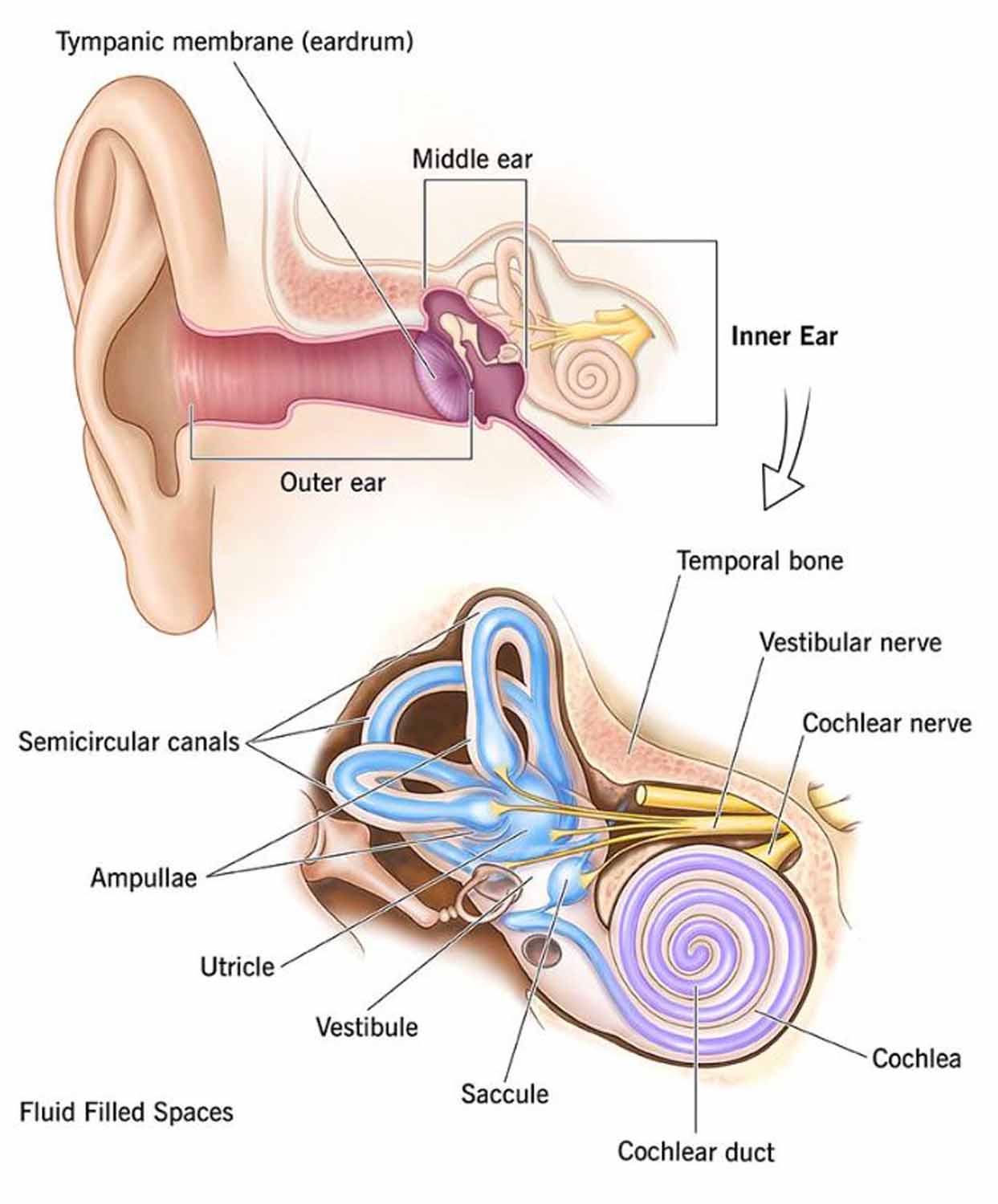
Occasionally, one or more of these three sources of information can get lost or damaged, causing the brain to get confused, not knowing which information source to believe. A blind person will have so-called “balance issues” until the brain learns to depend on one fewer source of information – even losing one eye can affect one’s ability to stay balanced. Diabetes patients who lose feeling in their toes often suffer similar loss. Other serious issues are often caused by the vestibule going berserk. When the crystals get displaced by physical trauma, or often as a result of surgery or infection elsewhere in the body, that distortion or loss of data to the brain can cause big trouble.

A few years ago, I elected to have my left shoulder joint replaced. Afterward, I proceeded to ignore the doctor’s orders, along with the advice of countless medical professionals by combining the pain medication with generous amounts of Chardonnay. When I passed-out on my way to the bathroom, I hit the back of my head pretty hard on the carpeted floor.
When I took the resulting benign paroxysmal positional vertigo (BPPV) to my doctor, he performed the recommended Epley Maneuver in his office. After doing some reading on the problem and repeating the maneuver a second time, still with no results, he sent me to an ENT, who performed his version of the maneuver twice before sending me to a specialist.
Her name was Elizabeth (Liz)[iii]I’m sure she would not object to me using her real name., a physical therapist specializing in vestibular issues, mainly in stroke patients and others, including patients following major surgery or surgical infections. It took her no more than 15 minutes to resolve the BPV, but I saw her 2 or 3 more times to learn and practice balance exercises that she recommended for old guys like me.