
Amateur Web Design & Development
scroll down for hints on using this particular one
I don’t claim to know very much about the subject, but I know all I need to know. So let this page stand as a place where I can send people to explain why I cannot answer their questions.
I have never written software, aside from a short time many years ago when I found myself needing to write assembly language for an Intel 80C8x, and had no one to help me. Creating and managing a website is not particularly complicated, but it has lots of moving parts that need to be coordinated. We can skip over definitions, like frontend/backend, design vs. development, and things like ICANN and the WEB because we can Google those as needed.
I have “designed” websites, and until a few years ago, I relied exclusively on my good friend and mentor, Matt Knowles, to “develop”, maintain, and “host” them for me. Matt grew up in the canyons of Silicon Valley and moved to Northern California some years ago, where he works from his home. I strongly advise others to talk with someone with his experience before jumping in or spending money.
I like to think of the current options in three categories.
If you are Honda or United Airlines or just an aspiring Procter and Gamble start-up, you are going to need an office building full of people and others in far-off places, writing code around the clock.
If you are stuck in the middle, like I am, you have some choices. There are Content Management System Development platforms like WordPress, Drupal, Magento, and Joomla. I have had experience with some of those, but I started using WordPress on Matt’s advice. I can do what I need with plugins and occasional help from Matt if I need to hard-code something. Here is a brief summary of a couple of the most popular tools.
If you want to publish your son’s soccer team schedules, you will likely be happy with one of the options available from Wix or similar – from GoDaddy and others. They all do the same things. You can even set up an online store, but that’s probably not the best place to do that.
At least for retail businesses, I generally think of a website as a place to store detailed information or keep existing customers advised of current offerings, rather than attracting new customers. Given the number of sites on the web these days, SEO is critically important, but the goal of attracting new customers might be better served with social media, which is better suited for “Glitz”[iii]floating windows, BGs, sticky side bars, and Widgets
All of these platforms or CMS[iv]Content Management Systems do pretty much the same things. Shopify is very much eCommerce oriented, as its name suggests. Wix has been around for a long time and still holds onto a significant market share. Drupal and Joomla have also been around for a long time, but neither has kept up with the competition, and are shrinking in market share. Squarespace follows the same business model as the other also-rans, but it has taken them over 20 years to carve out a 3% market share. It is clear that the D&D&P business model is a highly competitive one, and one that is likely to continue shrinking in the CMS market.
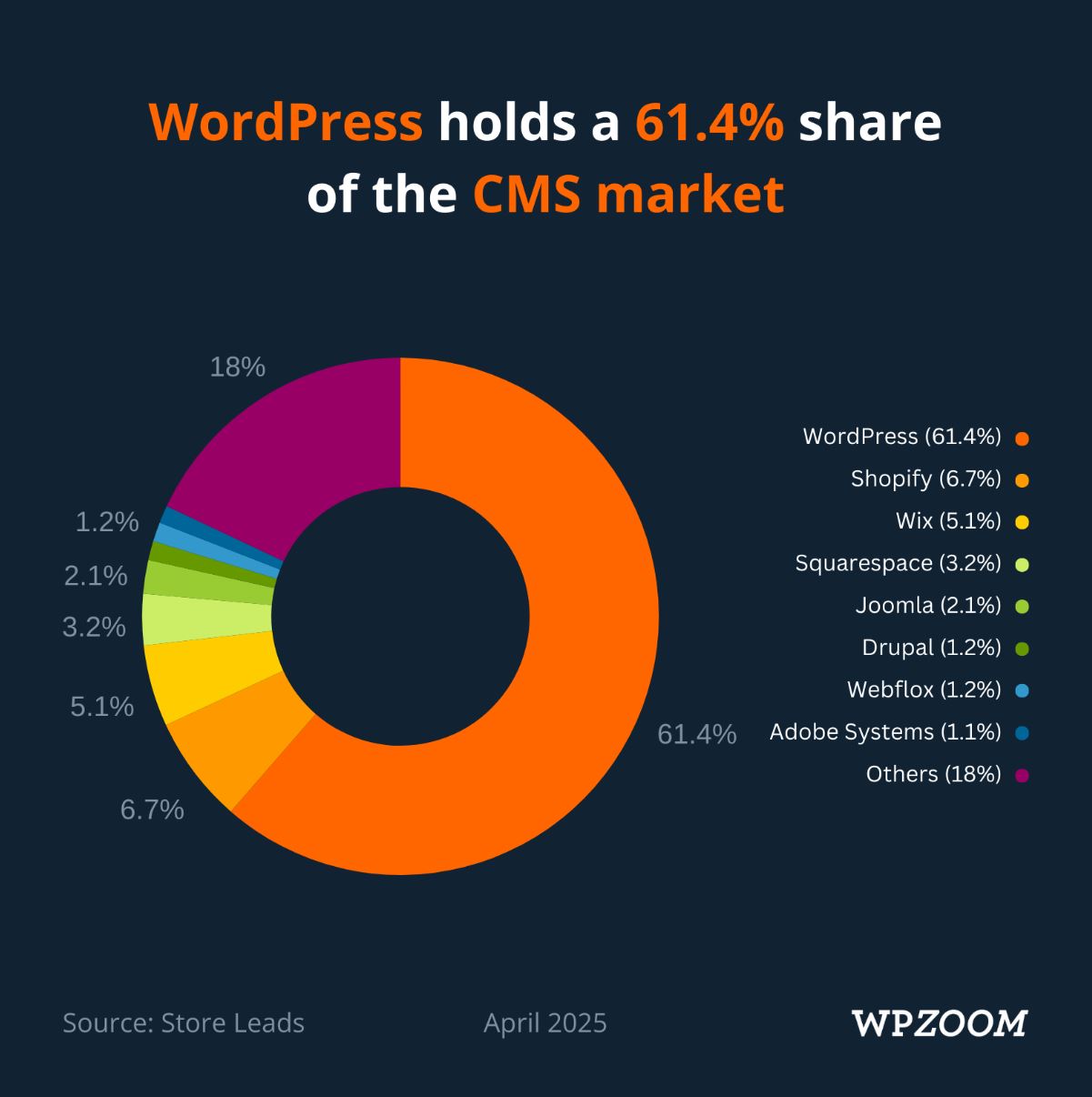
One thing that has led to the WordPress dominance is that, while it offers the typical D&D&P service through WordPress.com, it also serves the “Middle Ground” market with WordPress.org. Its D&D&P version has limitations similar to the other D&D&P competitors, while WordPress.org allows for full customization and plugin installation. That means you can do things with the .org version that cannot be done with the .com version or with the other D&D&P platforms.
Read or watch the details by going to YouTube – “wordpress.com vs wordpress.org”.
